
WE PICTURE a campground, a paved campsite, for a long weekend away from real life. But for a considerable number of full-time RVers, the RV is real life: a mobile office, a traveling nurse’s home base, a jobsite headquarters, or a sports family’s secret weapon. RVs have long been used for more than recreation. What has changed is the creativity full-timers bring when choosing the rigs for the job—plus the many models now available to choose from. From pipeline welders to cross-country moms, these are the real people using their RVs far beyond the traditional weekend getaway and the RVs that allow them to do so.
RV manufacturers are increasingly designing floor plans that expand how they get used. Built-in desks, dedicated office nooks, and Starlink-ready connectivity are becoming common, so that RVs are more adaptable than ever. Even still, owners have been ahead of the industry for years, finding new uses for traditional rigs long before the floor plans caught up to them.
Full-Time Pipeline Work In an RV
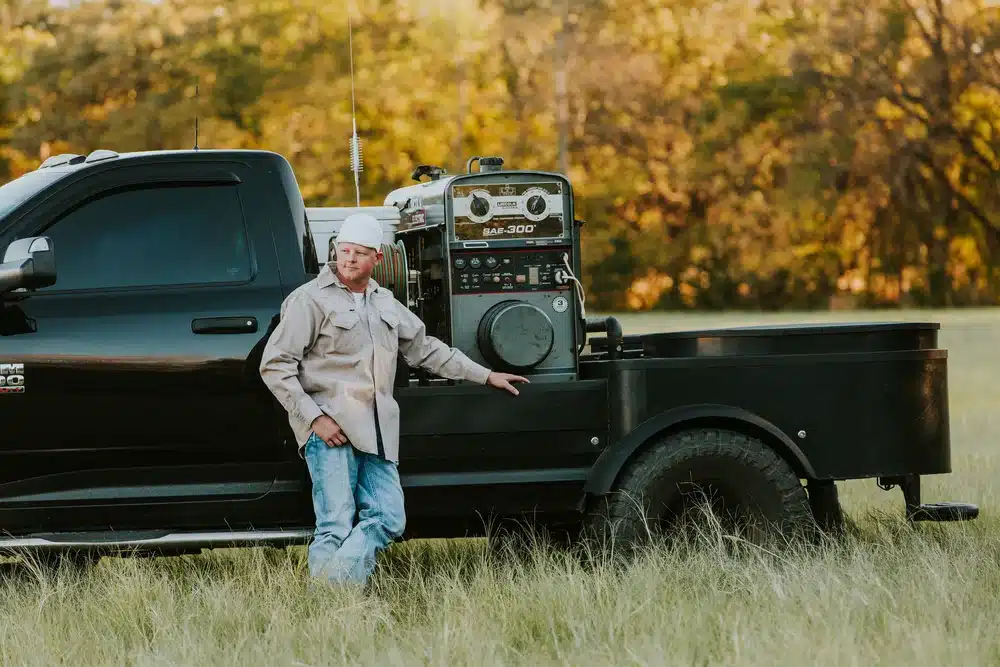
In the pipeline welding world, when a job opens up, you get a call, and it’s time to go. Sometimes it’s a few weeks’ notice, sometimes it’s two days. Either way, you need to be ready to move. For Austin Ross, an Oklahoma-based pipeline welder turned welding consultant and educator, an RV makes that kind of life possible.
Austin learned to weld during his senior year of high school and knew immediately that it was the career he wanted. Soon after, he found his way onto the pipeline and into an RV.
His first rig was a bumper-pull trailer from the mid-70s that he bought for a few thousand dollars. Within a year, he’d traded up to a 28-foot travel trailer with a super slide out, and that’s the one he took on his first real pipeline job in northeast Pennsylvania. From there, the rigs kept pace with his life: he got married, moved to Colorado, headed to Ohio, and eventually landed in a 45-foot Highland Ridge Open Range fifth wheel—front bedroom, rear living, mid kitchen—that became his family’s full-time home on the road for years.
The pipeline lifestyle often means relocating every few months, though a job could last anywhere from two weeks to a year. Hotels and extended-stay motels are the default for some workers, but for Austin, the RV offered more consistency. “Your home is the same… The best part, and the reason I like it, is because it’s the same, he said. “It’s the constant in your traveling. You might be traveling to different parts of the country—some jobs are three months, but it could go six months, a year—and the RV is just a nice constant.”
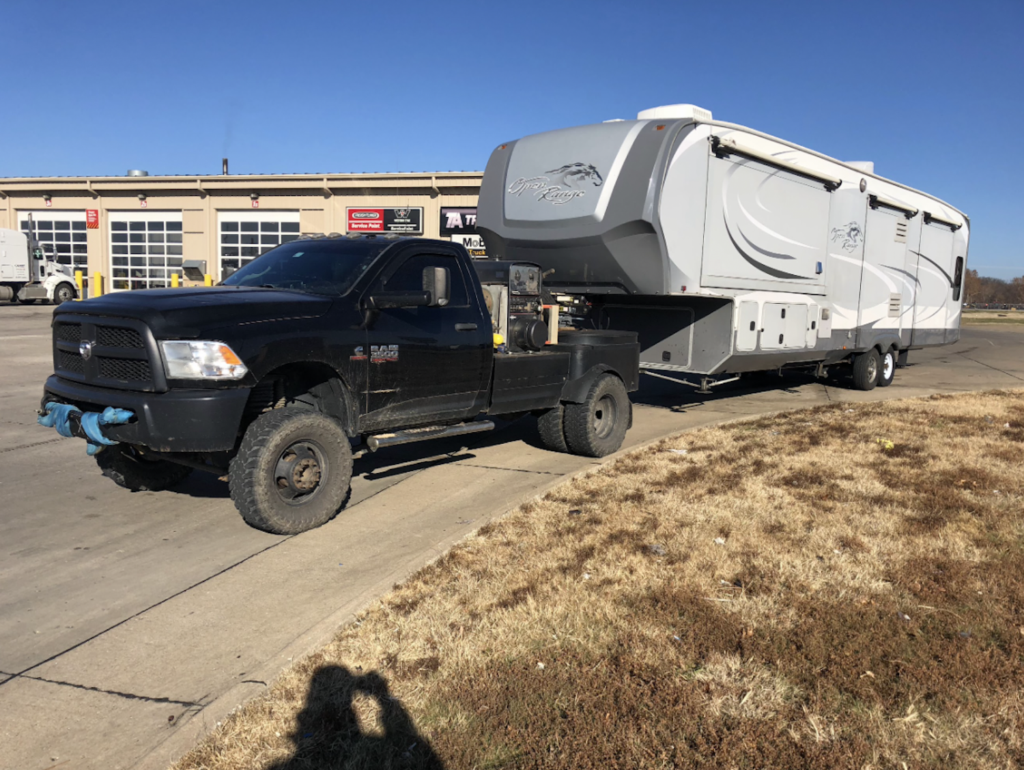
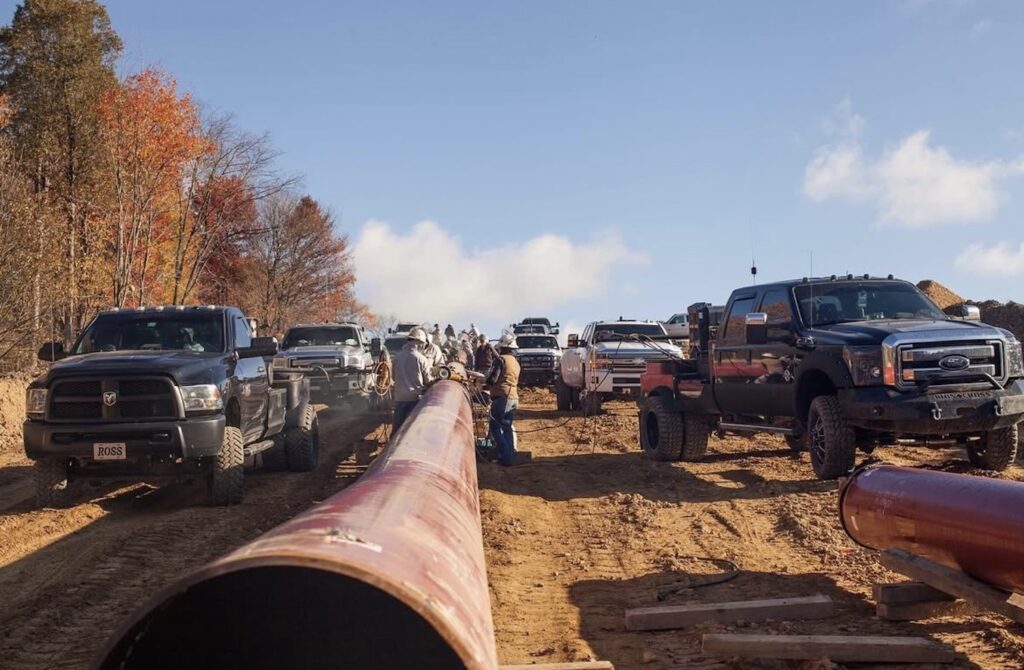
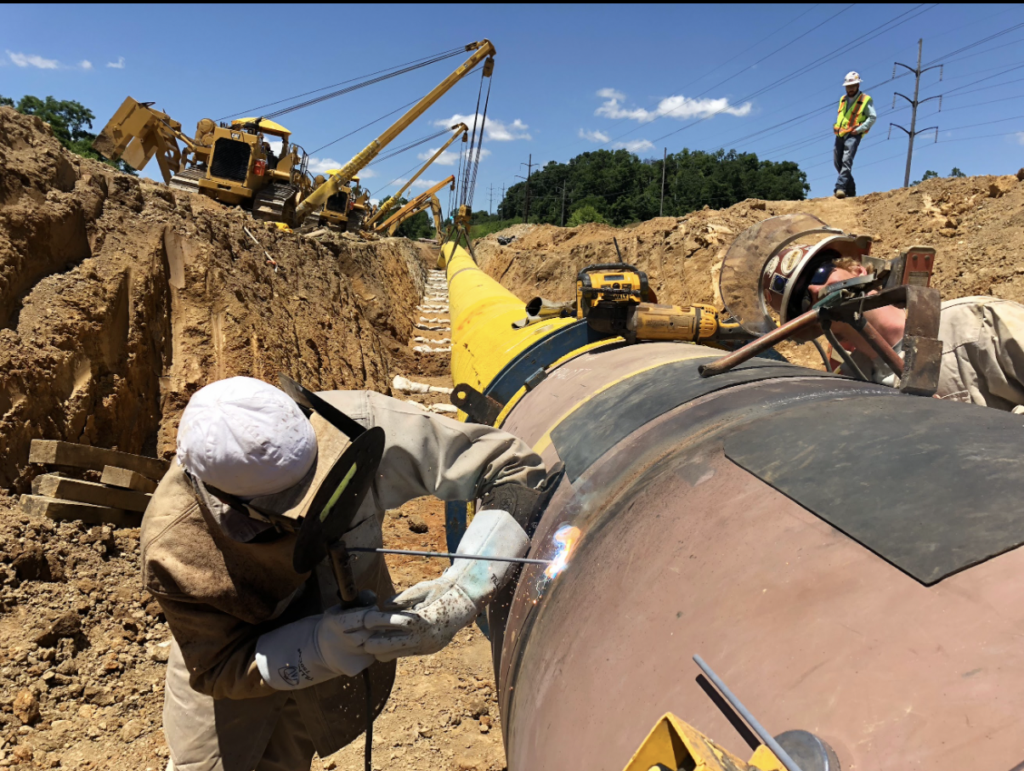
Images by Austin Ross
The Open Range gave his wife a real kitchen to cook in, his kids a bunkhouse, and everyone a living space that didn’t reset every time the job moved. Over time, they customized, replacing the factory blinds with actual curtains, swapping the rear couch for a desk when they launched an online business, and trading the dining room table for a deep freeze and an IKEA-style storage unit to keep the family organized.
Certain practical lessons came the hard way. A clogged black tank early on taught them to rethink what goes down the toilet. Blown tires taught them the importance of driving on new tires and keeping a spare on hand. And working through cold-weather jobs taught them that a heated water hose and skirting aren’t optional.
Finding a place to park wasn’t always simple, either. Last summer, Austin called roughly 10 RV parks around Norfolk, Virginia, before a job, but couldn’t land a single spot for a 40-footer. The summer crowd had everything booked. He’s learned to work the network: people already on a job site can point you toward smaller private properties with three or four hookup spots that don’t show up in any app. He also credits Furnished Finder, a platform designed for traveling nurses and other long-term workers, as a resource worth knowing about.
Today, Austin’s RV travel looks a little different. He has since downsized from the 45-foot Open Range to a 2018 Forest River Rockwood Lite—a lightweight, aluminum-framed travel trailer that’s easier to move on short notice. The reason is that his career has evolved. Through his YouTube channel (Austin Ross Welding), Austin built a following and began offering one-on-one welding instruction sessions, teaching pipeline qualification tests to aspiring welders across the country. What started in mid-2024 as a workshop in Oklahoma quickly became a national tour, with Austin traveling every week or two rather than settling into a single jobsite for months.
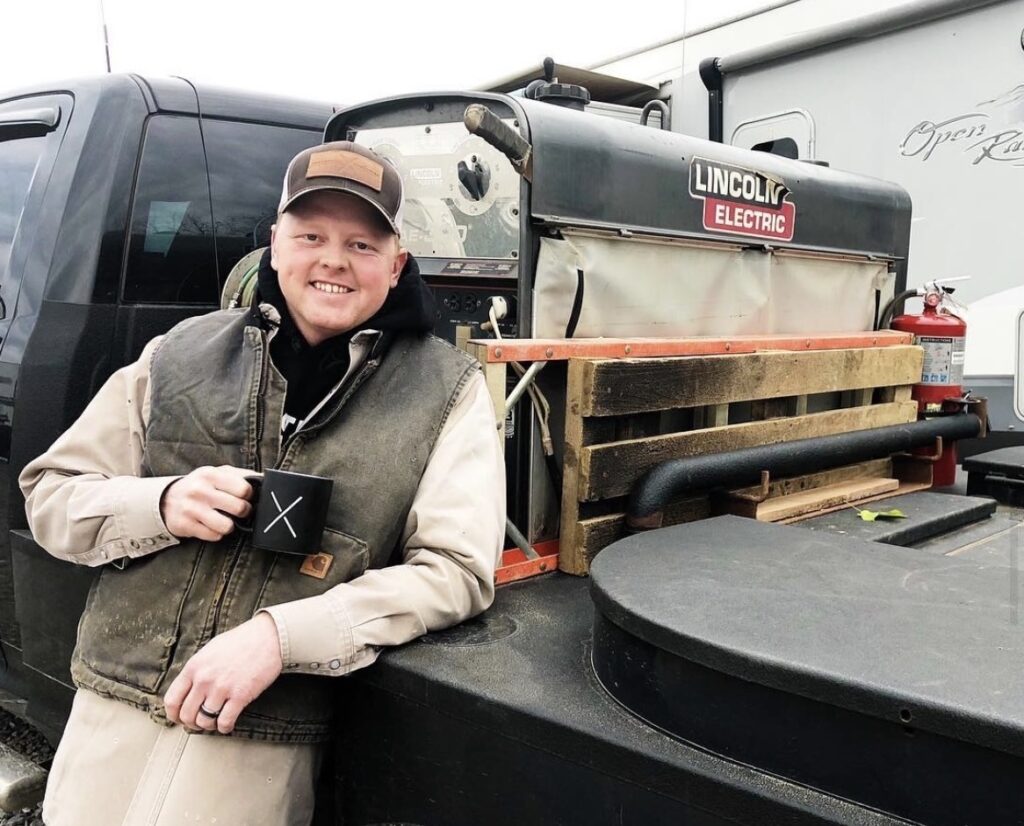
For anyone in the trades thinking about the RV route, Austin’s advice is straightforward: do your research before you start. Choose the right RV. Call ahead to RV parks. Know the size of your rig and whether you’ll fit in a campground. Lean on the people you’ll be working with, too—because they know the area and the hidden spots. And accept that sometimes living in a trailer while working the road is more effort than checking into a hotel. “It does come with work and you’re paying for it,” he says. “But if you can find a decent RV park, you can grill, it’s your little space—it’s just way nicer to live in versus a hotel.”
Broader Context
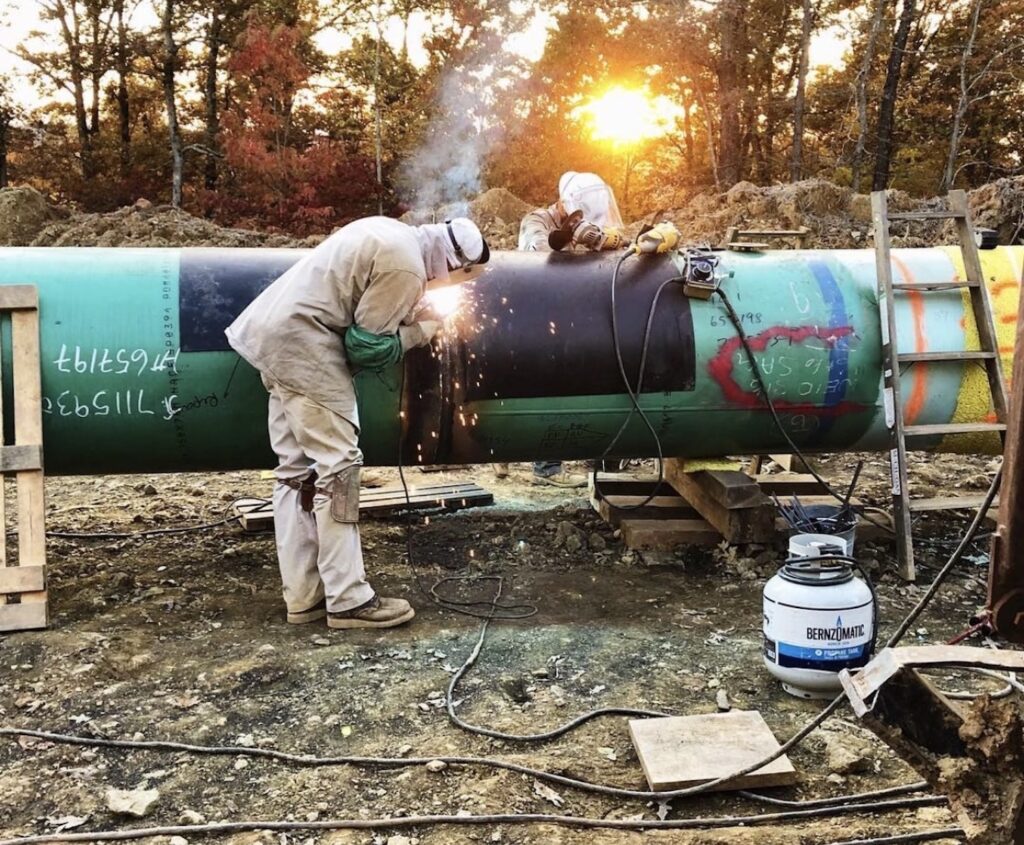
Pipeline workers, linemen, oilfield crews, and traveling tradespeople have long used RVs as jobsite housing. Companies sometimes provide crew camps, but many workers prefer their privacy, comfort, and the ability to bring family along. Construction crews on temporary assignments increasingly choose RVs over extended-stay motels to save money and improve their quality of life.
RV Like This
There’s a reason fifth wheels are the default in the trades. The hitch sits over the truck’s rear axle, which means more stable towing over long highway miles — and a free truck bed for welding rigs, tools, or whatever your job demands. A luxury fifth wheel takes it a step further with residential appliances, four-season insulation, and floor plans designed for comfort.
Our Pick For Couples | Jayco Pinnacle 38FBRK
Images by Camping World
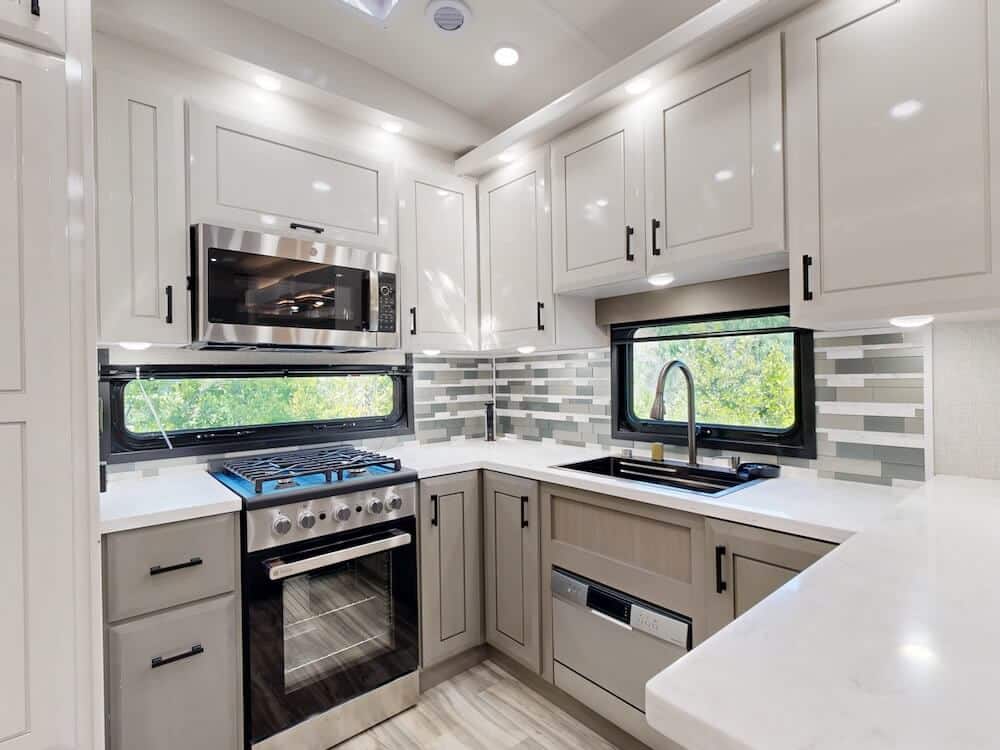
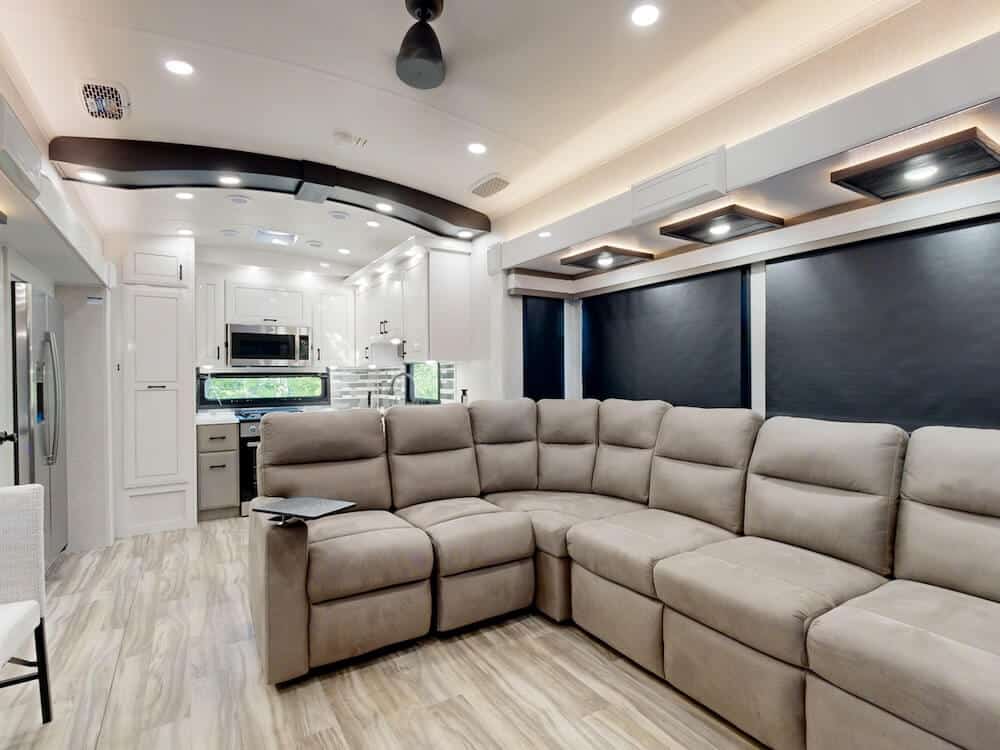
Three slides open the Pinnacle into a space that includes a rear kitchen where you can cook a real dinner, a living room with theater seating, and a front bedroom with a king bed and walk-in closet. It’s zero-degree-rated, so your water lines are more likely to survive a January jobsite. Washer/dryer prep means no hunting for a laundromat in a town you don’t know. Hydraulic auto-leveling means makes for a quick setup after a long drive.
Our Pick For Families | Forest River Sabre 37RVMILES
The Sabre solves the problem many families run into on the road: where does everybody go? The front bedroom is yours. The rear den is theirs, which is a private second room with a sleeper sofa, a loft above for the kids, a built-in desk, and a projector for movie nights. That’s the flexible space Austin and his wife cobbled together with MDF and IKEA furniture, except it comes standard. Between the two, the main living area opens onto an electric side patio deck.
Healthcare on the Move — Traveling Nurses
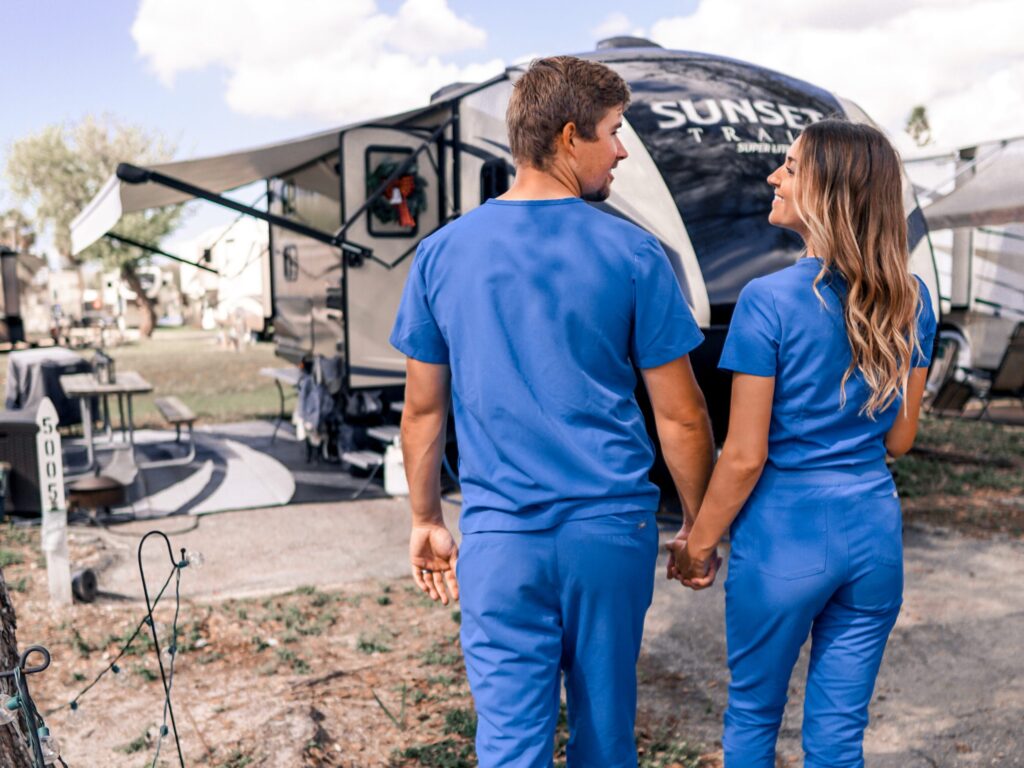
Chase and Lindsay grew up camping separately but spent summers at the same campground in Myrtle Beach before they ever met. Years later, they got married at that same campground on the beach. They’d talked about owning an RV and traveling as a family, and then travel nursing made that dream a reality.
Both are ICU nurses who spent four years on staff before transitioning to travel nursing. Their assignments typically last a few months, and every contract means a new city, a new hospital, and a new set of routines. Finding clean, safe, affordable short-term housing is one of the most stressful parts of the job. The RV eliminated all of it. “As a travel nurse, everything is always changing and every contract you have to adapt to all of the changes,” Lindsay said. “Having our RV keeps one thing constant.”
They started with a 30-foot Crossroads Sunset Trail travel trailer that worked well for about five years—good kitchen appliances, easy to find spots for, enough space for full-time living as a couple. Then, they added a Travel Lite truck camper so they could take weekend trips without unhitching their home every time. And when they decided to start a family, they upgraded to a 45-foot Keystone Fuzion toy hauler, turning the garage into a nursery for two kids.
That garage conversion is the kind of flexibility that makes toy haulers popular with full-timers. The same space that hauls gear for one owner becomes an office for another or, in Chase and Lindsay’s case, a baby room. They installed a washer and dryer, gained side and rear patios for extra living space, and landed in a rig that finally felt sized for the life they were building.
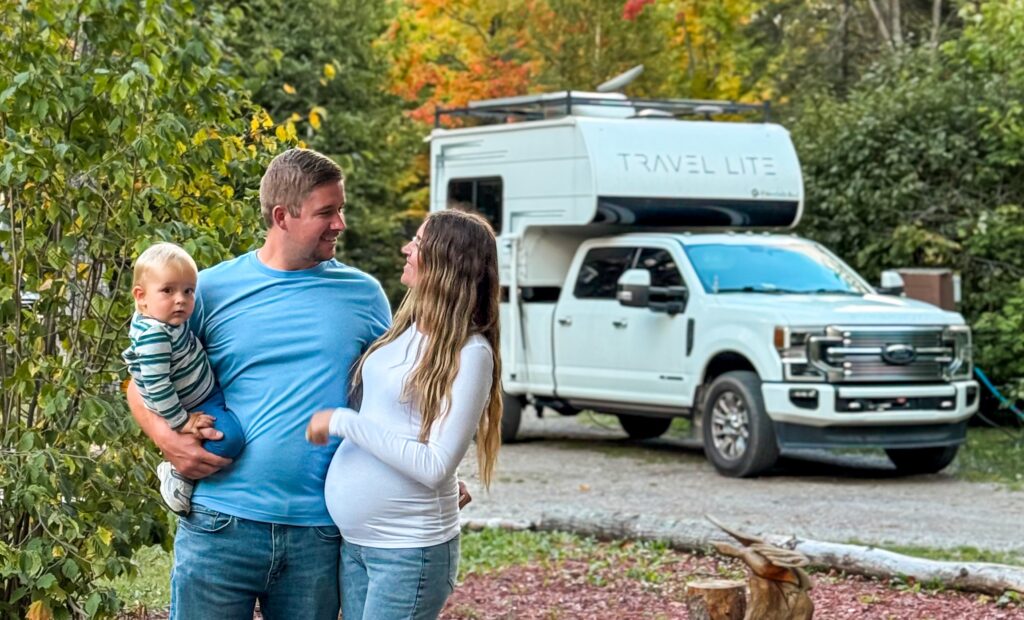
The logistics of travel nursing aren’t effortless. Campground bookings are tricky when you can’t plan more than a few weeks out. Contracts can get cancelled before they start (making flexible cancellation policies important). And some campgrounds only allow short-term stays or have age-restrictions. But Chase and Lindsay have consistently found spots within 10 to 30 minutes of their hospitals, and after nine years on the road, the system works.
Chase handles three 12-hour night shifts in a row, stacking them to open up stretches of days off. Lindsay stays home with the kids on work days. On days off, they explore their temporary city, relax at the campsite, or load up the truck camper for a weekend trip without moving the house.
Their advice for anyone considering it: “Get the biggest truck from day one. That way, there are no limitations to what kind of camper you can get or upgrade to in the future.” And for nurses who haven’t thought about an RV yet: “It’s a great option if you want to take your home with you, no matter where you work. This is especially great if you have pets or a family—they will always have a constant home, but your backyard just changes.”
Broader Context
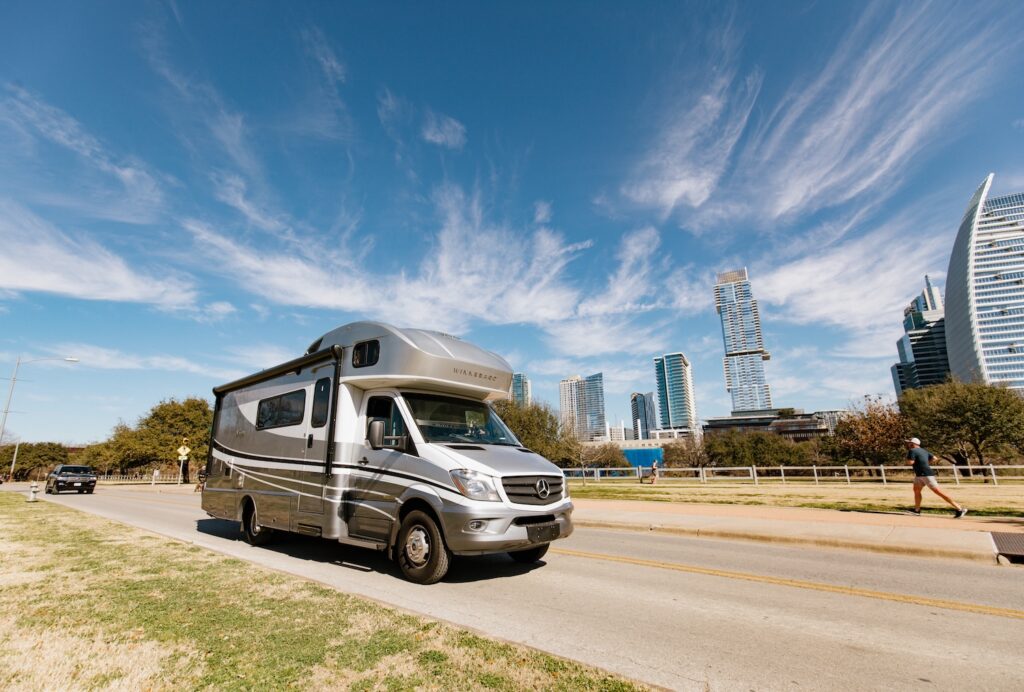
The traveling healthcare workforce exploded during and after the pandemic, and many nurses discovered that bringing their own housing was cheaper and more comfortable than corporate apartments or extended-stay hotels. The RV gives them consistency of the same bed, the same kitchen, and the same routine, even as the zip code changes every few months.
RV Like This
Travel nursing demands a rig that’s a genuine full-time home, not a weekend camper you’re tolerating between assignments. You need a real kitchen for meal prep between shifts, a bathroom you don’t have to share with other campers, and something that can relocate every few months without moving day becoming a project. Chase and Lindsay started with a travel trailer and upgraded to a toy hauler as their family grew.
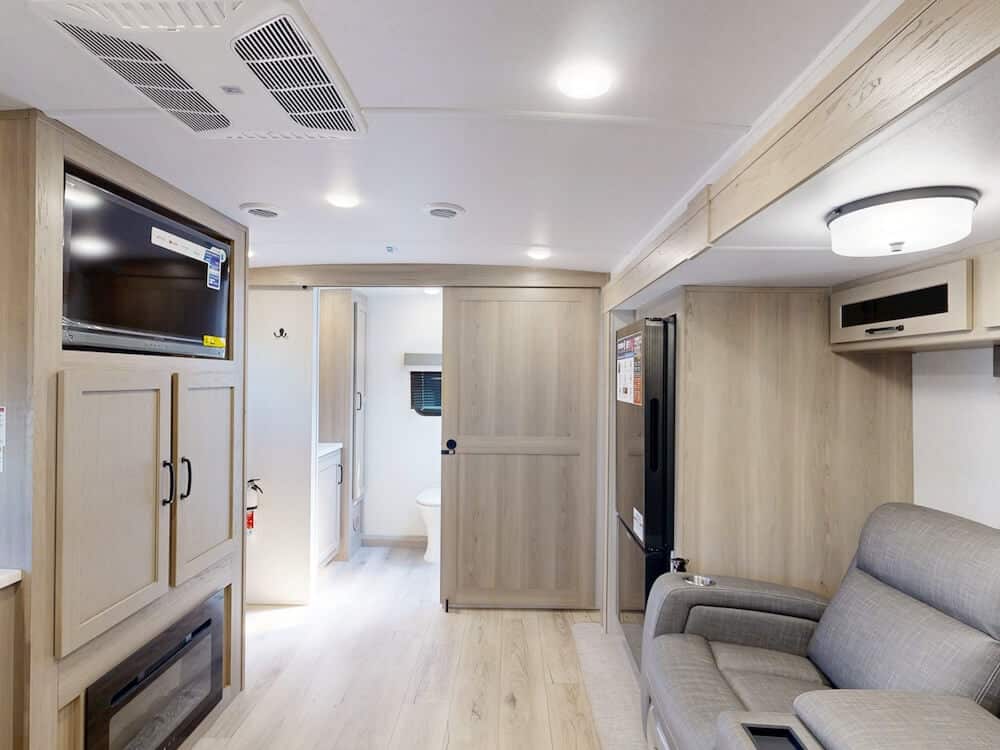
Our Pick For Couples | Forest River Rockwood Mini Lite 2511S
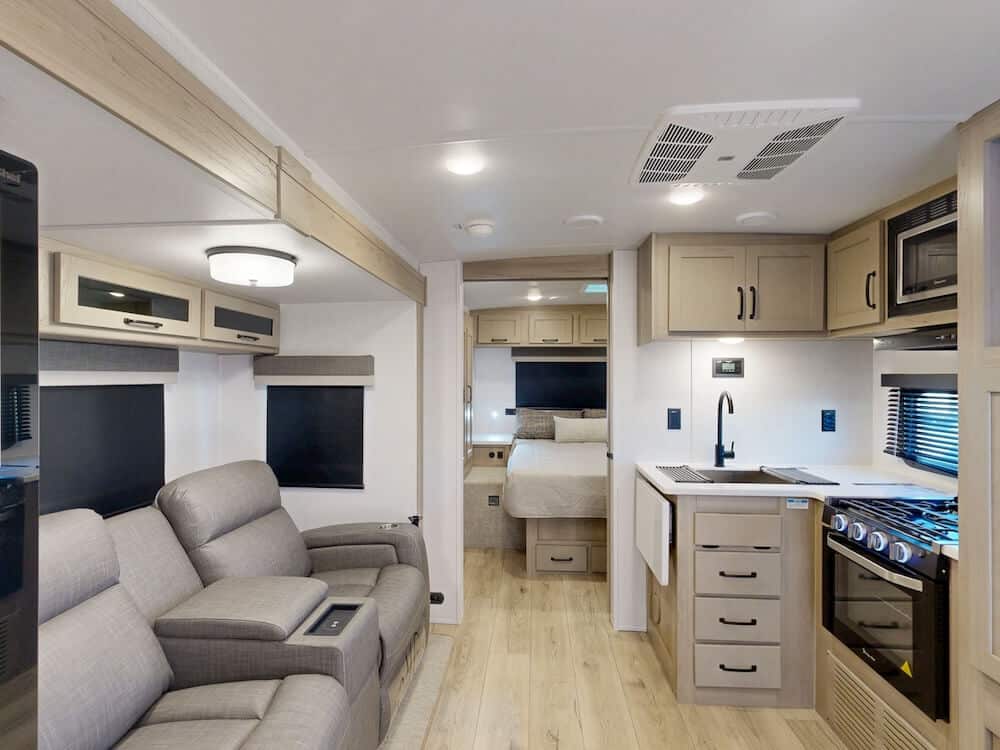
Images by Camping World
At just under 26 feet and around 5,800 pounds, the Rockwood Mini Lite 2511S is light enough to tow with a half-ton truck and short enough to fit into more campgrounds, a real advantage when you’re booking last-minute in competitive markets. A wardrobe slide-out gives you actual closet space for a nurse who lives out of more than a duffel bag, and the full kitchen handles real meal prep. It’s the kind of trailer Chase and Lindsay lived in comfortably for five years before kids changed the equation. For a couple testing the travel nurse RV life, this starts you out on good footing.
Our Pick For Families | Dutchmen Eddie Bauer Expedition 295BH
When the kids arrive, you need a rig where everyone has space. And, ideally, that space is versatile. The Eddie Bauer Expedition 295BH is a 35-foot bunkhouse travel trailer with rear twin bunks that fold up to turn the space into a “gear garage” when needed, for bikes, strollers, or whatever the current stage of family life demands. The main living area has theater seats and an L-shaped sofa. The full kitchen has a French-door fridge and a 3-burner range. And, outside, a 20-foot power awning turns the campsite into a second living room. At around 7,400 pounds, it’s towable with the kind of truck Chase and Lindsay would tell you to buy from day one. There’s enough room for a family to live in for months at a time without feeling like they’re camping.
The Sideline — Youth Sports Families
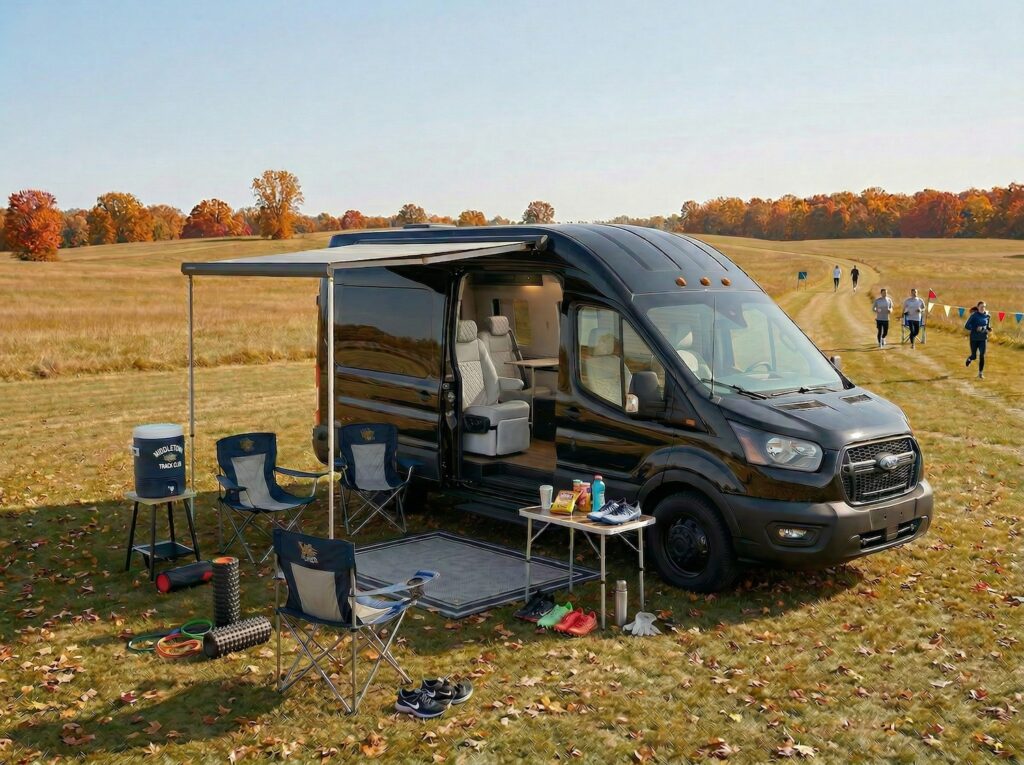
The scene is familiar to any sports parent: a Wednesday afternoon, an away cross-country meet an hour from home, 40-degree drizzle, and two hours to kill between races. When Kristen Schmitt’s family was attending races for her daughter’s cross-country meets, their setup included a Class B camper van that, from the outside, looked like any other cargo van in the parking lot. On the inside, it was a warming station, a bathroom, a kitchen, and a place to sit down that wasn’t a soggy camp chair.
“For mid-week cross country meets that are an hour or more away, we take our RV because it’s got everything we need between races,” Kristen says. “A bathroom, a way to warm up—and the best part—dinner in minutes thanks to the propane two-burner stove.”
For families deep in the youth sports grind—cross-country in the fall, travel tournaments on weekends—the RV becomes less of a recreational vehicle and more of a mobile support station. Kids can warm up, change, eat a real meal, and use an actual bathroom instead of a porta-potty. Parents get a place to regroup that isn’t the driver’s seat. And when the meet is over, dinner’s already handled before the drive home.
During the pandemic, the same van pulled double duty in ways Kristen hadn’t anticipated: grocery runs with a bathroom onboard when public restrooms were closed, a month-long stay in Florida that blended into the neighborhood because the van looked like a regular vehicle, and a way to visit family several states away when traditional travel felt risky.
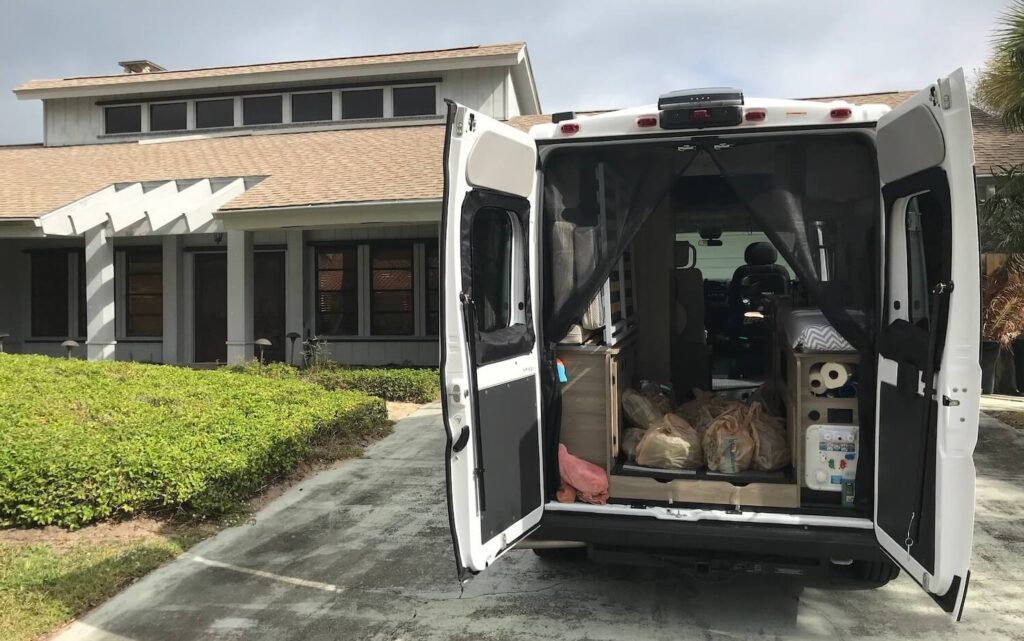
But even outside of extraordinary circumstances, Kristen’s family has found the van earns its keep in surprisingly ordinary ways—hauling home boxwoods and fruit trees for landscaping projects, carrying basement shelving, and transporting 5’ by 5’ canvases for her husband’s painting. “RVs have a lot of hidden potential that goes beyond the basic road trips,” Kristen says, “though those are fun, too.”
Broader Context
Youth sports travel is one of the biggest hidden expenses for some families. Club sports like hockey, soccer, and track can mean weekend tournaments hours from home and all the costs that come with that. An RV doesn’t eliminate those costs, but it can help: no hotel rooms, no fast food out of necessity, and a familiar space that makes the whole routine sustainable. Kids can nap, change, eat, and relax in a familiar space. For multi-day tournaments, the RV is an excellent home base.
RV Like This
A Class B camper van is the sports parent’s secret weapon because it doesn’t look or drive like an RV. It fits in a school parking lot, navigates a suburban pickup line, and doubles as a daily driver the rest of the week. But inside you’ve got a bathroom, a kitchen, climate control, and enough space to turn a miserable sideline day into something manageable. Kristen’s family used a Winnebago Solis. But for families looking at something purpose-built for the sports life, the category has even more options now.
Our Pick | Thor Coleman 17D Pop-Top
Built on a nimble RAM ProMaster® chassis, the Coleman 17D Pop-Top offers the perfect blend of agility and adventure for families or small groups. While it retains the easy driving and parking of a standard van, the innovative pop-top roof expands your living space, allowing you to comfortably sleep up to four people. The interior features a kitchenette with a portable induction cooktop, a mini fridge, and solid counterspace. The rear flip-up bed expands the cargo area to accommodate inflatable paddleboards, bikes, and other adventure gear.
Discover one of our favorite RV tour channels online: Beer Run Bus.
The Rolling Office — Full-Time Remote Work
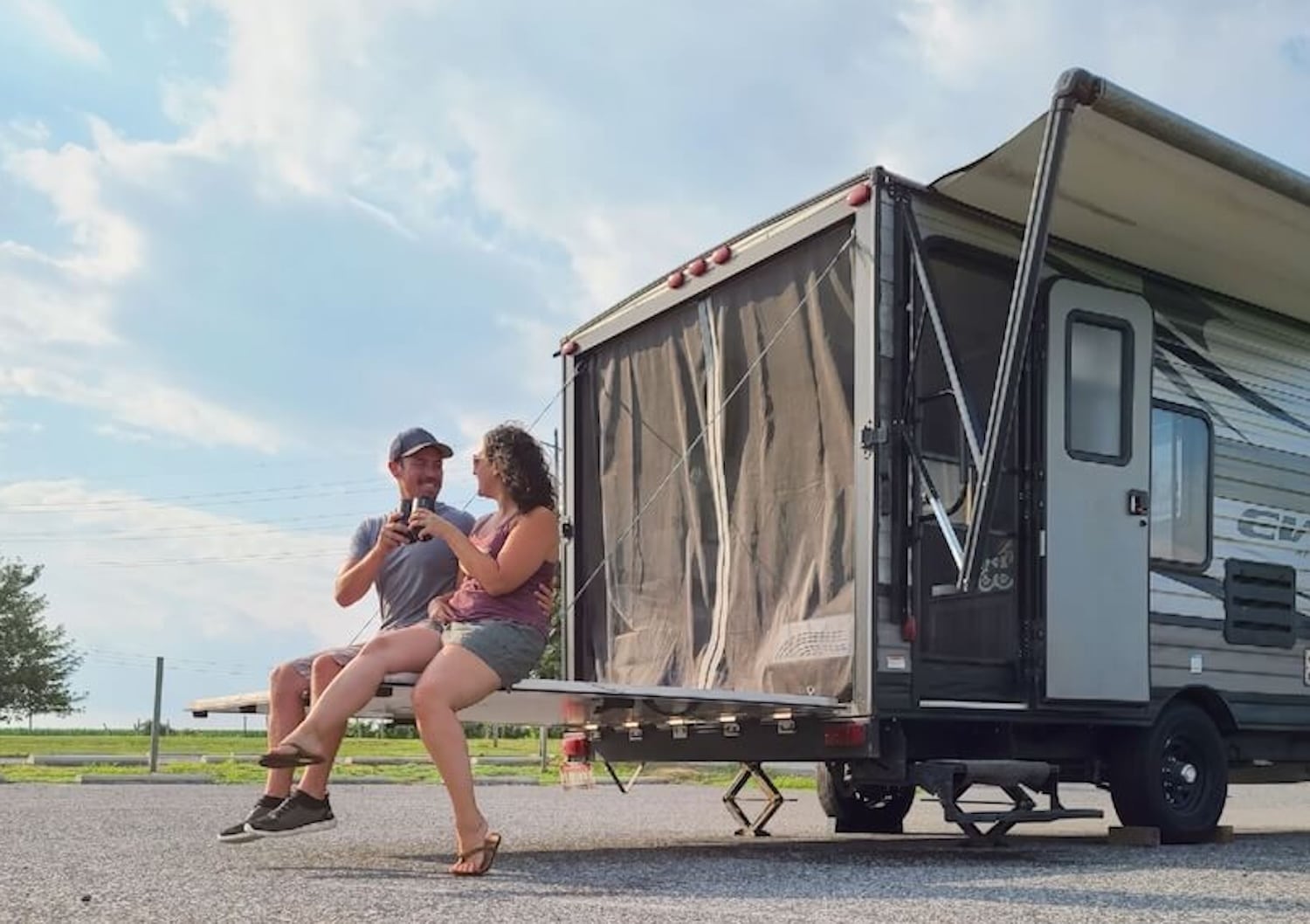
The idea started in college, when somewhere between lectures Kerisa Kiele Tiongson decided she wanted to travel full-time and see all 50 states. She graduated, moved, settled into a customer service desk job, but the idea didn’t go away. And she soon started writing down places she wanted to see when she got out of there — New York City, Key West, Acadia National Park, Route 66.
After meeting Anthony in 2018, they started spending every three-day weekend driving close to a thousand miles round-trip to Utah and back in a teardrop trailer. Then one evening, sitting on their Southern California balcony, Kerisa decided she had to find a way to travel full-time.
Between her copywriting side hustle and Anthony’s personal training business—and after selling Anthony’s car—they pulled out of Idaho in a 2020 Forest River EVO 178RT — a small toy hauler, just over 21 feet long, towed by a Toyota Tacoma — with their dog Butters, their cat Tiskies, and a goal of hitting all 48 lower states.
They did it in eight months, 35,000 miles, crossing into Arkansas, their 48th state.
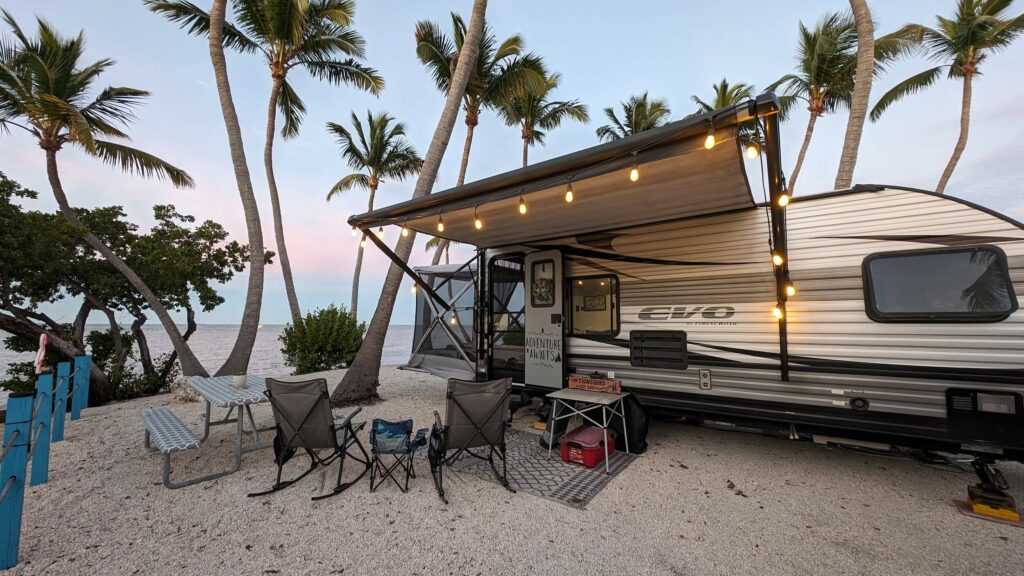
The original plan was to come home after that. Instead, they got married—in Big Sur, on the ramp door patio of their trailer—and what was supposed to be a once-in-a-lifetime trip turned into a full-time lifestyle. They slowed down, found a rhythm, and kept going. Kerisa became a full-time freelance travel writer and content creator. Anthony started workamping seasonally at campgrounds they’d fallen in love with.
“The housing market in Idaho skyrocketed and we suddenly found ourselves unable to afford to go back home anyways, so we considered it a sign to keep going – and it’s completely changed our lives!” Kerisa said.
The EVO is still home, over five years and counting, well past what most people would consider the lifespan of a budget trailer for full-time use. Their living room is also their dining room and Kerisa’s office. Every night, she stores her laptops, planner, and notepads in a bin under the couch and sets the table with placemats and nice plates so the space feels like a dining room instead of a cubicle. Every morning, she pulls it all back out before anyone else is up. “It sounds redundant,” she says, “but just like anyone who works from home, it’s important to separate the two worlds when you clock out.”
The physical toll is real. The couch wasn’t designed to be sat on for 45-plus hours a week for five years, for example. She wears a Fitbit to remind herself to move every hour, and at the end of the day she sprays sage to clear the workspace energy. Her internet setup is Starlink satellite backed by Verizon 5G hotspots. “Do not rely on campground WiFi,” she warned. “You’re setting yourself up for disappointment.”
Learn more about Kerisa’s Full-Time RVing in a 2020 Forest River EVO.
The trade-offs extend beyond the desk. Things break faster when your house goes through what Kerisa describes as the equivalent of an earthquake every time it moves — cabinet bowing, hinge failures, a cosmetic wall that cracked and splintered from frame flex. Yet Kerisa considers them lucky. Up until recently, the EVO hadn’t experienced any major mechanical issues, and she credits that to consistent TLC and reinforcement. They’ve added bracing to cabinets and the bed frame to prevent bowing under the added weight of full-time living. They’re currently replacing an axle.
With the EVO in the shop for the axle, they’ve been renting a Forest River Salem travel trailer, and it has only affirmed their love of the toy hauler. The next rig will be a toy hauler again, non-negotiable.
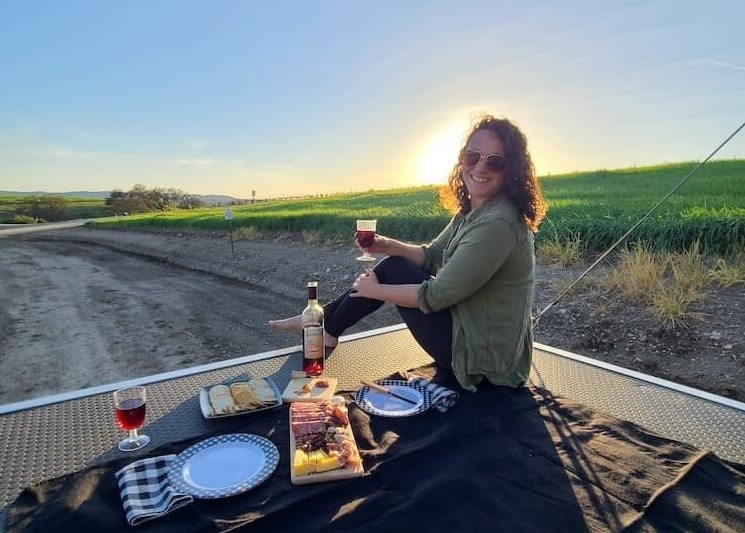
Image by Kerisa Kiele Tiongson
Anthony recently accepted a year-round permanent position at a new RV resort in Washington — turning what started as odd jobs into a full career built around the lifestyle
“RV life has not just become a part of our lives, but our way of life,” Kerisa says. The community surprised her most. “We have met some of the most amazing people on the road and have had literally life-changing conversations with complete strangers, and the only thing we had in common was RVing.”
Her advice to anyone working remotely who’s thinking about it: “Try it. Just try it for even six months. Worst case is you hate it, but at least you can say you tried. But be careful — it’s addictive, and before you know it, six to eight months can turn into 68 months like our story, in the blink of an eye.”
Broader Context

By the end of 2024, roughly one in five American workers were logging in from somewhere other than the office, and a growing subset have realized that “work from home” doesn’t mean staying put. The RV Industry Association has tracked a sustained increase in younger, working-age buyers since the pandemic, people who aren’t retired or on vacation but have restructured their careers around location independence.
RV Like This
The remote work revolution made the RV lifestyle accessible to a much broader audience. RV manufacturers have responded with built-in desks, swivel workstations, Starlink-ready rooftop preps, and floor plans designed with dedicated office nooks. Starlink RV satellite internet has been a game-changer, providing reliable connectivity in rural and remote locations where cell signal is weak. With reliable internet and a dedicated workspace, an RV becomes a fully functional office with a view that changes at your whim. Class B+ vans, travel trailers, and fifth wheels are popular among remote workers. In Kerisa’s example, a small toy hauler was the perfect hybrid.
Our Pick | Forest River Salem FSX 163RDSK
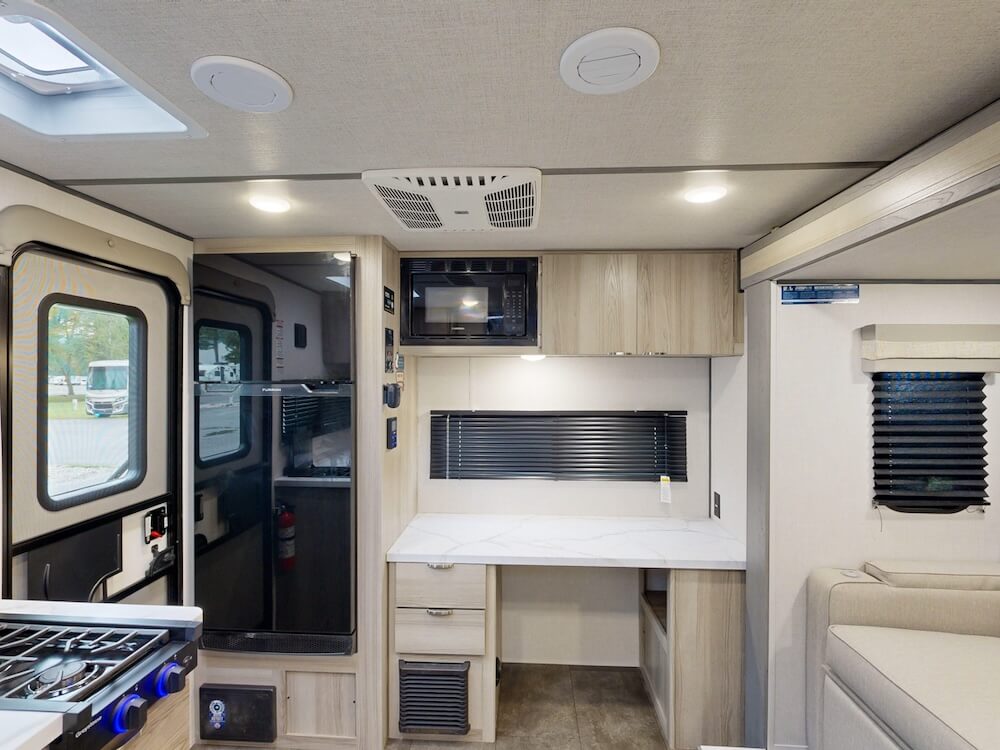
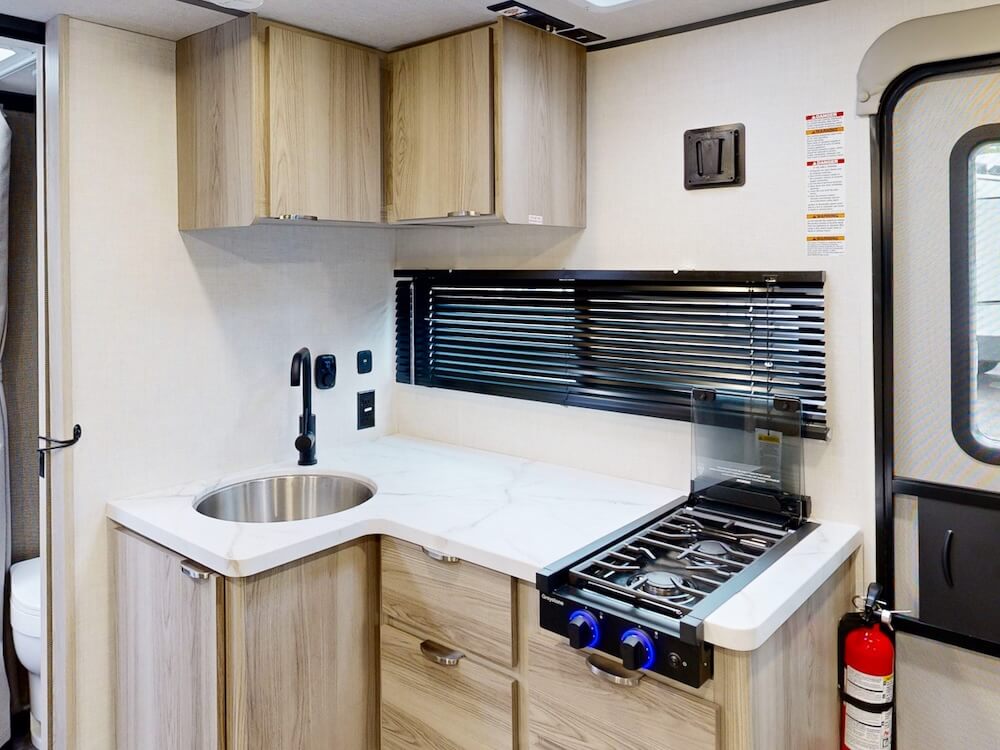
Images by Camping World
Kerisa’s toy hauler inspired us to find something affordable yet exceptionally capable for remote work. That’s the Salem FSX 163RDSK. Its unique rear room with a single slide-out houses a desk and work area, kitchen, and theater seating, giving you a dedicated workspace that doesn’t disappear when it’s time to cook dinner. At just under 23 feet and around 4,300 pounds, it lives in the same compact, mid-size-truck-towable world as Kerisa’s EVO: small enough to fit in any national park campground, affordable enough that the leap to full-time life doesn’t start with a massive financial risk.
What Other Ways Do RVs Work?
The same qualities that make RVs work for a pipeline welder or a traveling nurse—self-contained, mobile, ready when you are—make them work at scale elsewhere. Entire industries and emergency response networks have figured out what individual owners already know: when you need shelter that shows up fast and moves easily when the job’s done, nothing else comes close.
The New Boomtown
The AI boom is building data centers in places that lack enough hotel rooms to house the crews constructing them. In Abilene, Texas, the city approved a nearly 1,000-space RV park specifically for data center workers. In Holly Ridge, Louisiana, a 31-acre RV-based workforce village went up to support a Meta facility. It’s the same pattern the oil segment made familiar a decade ag. Hundreds of workers were in rural communities without housing, and RVs were the fastest, most flexible housing solution available.
Disaster Relief
In the wake of a devastating wildfire or hurricane, RVs are often the first real shelter available. Better than a cot in a gymnasium, RVs provide a private space with a locking door, a kitchen, and a bathroom. FEMA has deployed travel trailers for decades, but non-profits are filling the gaps:
- EmergencyRV was founded after the 2018 Camp Fire destroyed Paradise, California.
- Habitat for Humanity’s RV Care-A-Vanners sends volunteers to disaster zones to rebuild.
- RVs Without Borders frequently connects owners willing to loan rigs with families who’ve lost everything.
From a jobsite in Oklahoma to a data center in Texas to a fire zone in California, the through line is the same: the RV goes where it’s needed. The best rig is the one that fits your life — not just your next trip.
Check out the following resources for more ideas about how to work from your RV.
- Best RV for Working Remotely
- Best RV for Full-Time Living
- Small Toy Haulers
- How To Find the Right Vehicle to Tow Your RV
Have you worked from your RV? Let us know all about your experience in the comments below.


If you are looking at a forest river product,look in the corners at all the
Trash and debris that are there. Read the complaints and comments
Before even considering the purchase. Don’t depend on the commissioned
Sales person to tell you. I have moved over to winnebago and haven’t looked back.
Hi John,
I think the advice to look closely at fit and finish, along with reading up on owner reviews, is a good recommendation, regardless of the manufacturer!