
Winterizing is an essential step to protect your RV’s plumbing system when temperatures drop, and a key part of that is using RV antifreeze. Still, many RVers have questions about which type to choose and how to use it correctly.
When RV antifreeze isn’t applied properly, water can remain in the system, causing frozen plumbing, damaged pumps or fixtures, and costly repairs once temperatures rise—all problems winterizing should prevent. So let’s figure out the antifreeze that’s best for your RV and everything you should know about using it the right way.
Key Takeaways
- RV antifreeze protects plumbing by replacing water with a freeze-resistant liquid—propylene glycol (ethanol-free) is the safest choice for potable water systems, while automotive antifreeze must never be used in RV plumbing.
- Most RVs require 2–4 gallons to winterize, ensuring lines, P-traps, and tanks are protected; avoid filling the fresh water tank with antifreeze and instead pump it directly through the plumbing.
- When de-winterizing, flush antifreeze through fixtures and properly dispose of it at a dump station or sewer connection; RV antifreeze is non-toxic but should not be ingested or dumped on the ground.
Need a refresh on how to winterize your RV?
What Is RV Antifreeze?
RV antifreeze does exactly what its name suggests: it prevents the water in your plumbing system from freezing. By replacing the water in your lines with a liquid that has a much lower freezing point, you protect your pipes from expanding and potentially bursting in cold weather.
Frequently referred to as “the pink stuff”, antifreeze actually comes in a variety of colors—but the color is simply dye added so you can see it in your plumbing lines and has no impact on its performance.
What does matter is the type of antifreeze you use.
There are two main types of RV antifreeze you’ll find on the shelf: propylene-glycol blends that contain ethanol and ethanol-free propylene-glycol formulas. Sometimes marketed as “alcohol blend,” ethanol blends are the lower-cost option, but they’re flammable, can dry out seals, often leave a strong taste or smell, and are not considered safe for potable water systems.
Ethanol-free propylene-glycol antifreeze is non-toxic, gentle on plumbing components, and is the recommended choice for winterizing RV drinking-water systems.
Some “RV & Marine” antifreezes labeled as “propylene glycol” are actually mixtures of PG and ethanol. They may list PG first, but ethanol is still present and still includes some of the same drawbacks: flammability, taste/odor, drying of seals.
RV Antifreeze vs Regular Antifreeze
RV antifreeze and regular automotive antifreeze serve very different purposes, and they are not interchangeable. The antifreeze used in your car or motorhome’s engine is a coolant formulated for high-temperature environments, while RV antifreeze is specifically designed for winterizing plumbing systems.
Ethylene Glycol is the form most commonly used in automotive antifreeze. Propylene glycol is the non-toxic antifreeze used in RV preparations. Since the potable water system can never be 100% cleaned out when dewinterizing, the automotive, ethanol-based products must never be used to winterize the RV.
Technician Tip: Using regular antifreeze in your RV’s plumbing system is dangerous. It can contaminate your water system, damage components, and create a hazardous cleanup. Likewise, RV antifreeze cannot withstand the temperatures and pressures inside an engine.
Is RV Antifreeze Toxic?
Propylene glycol RV antifreeze is a non-toxic solution safe for RV plumbing systems and holding tanks. That said, you should still completely flush antifreeze and sanitize an RV fresh water system when de-winterizing your RV.
You should never dump RV antifreeze directly onto the ground when flushing your system. Improper disposal can allow the solution to leach into soil and waterways, where it may harm plants or aquatic life.
Is RV Antifreeze Toxic to Animals?
When using RV antifreeze or other winterization chemicals, your first step should always be reading the product label. RV antifreeze is formulated to be safe for plumbing systems, but it is not meant for consumption by humans or animals.
Propylene glycol is generally recognized as safe, but pets should never be allowed to ingest it. Ethanol-based antifreeze can be harmful in much smaller amounts. Cats in particular can be sensitive to certain glycols, and dogs may experience illness if they swallow large quantities of any antifreeze.
Fortunately, winterization and de-winterization are short processes. Keep pets indoors while handling antifreeze, clean up any spills, and store containers out of reach.
If your animals accidentally consume RV antifreeze, please seek immediate veterinary attention.
How Much RV Antifreeze Do I Need?
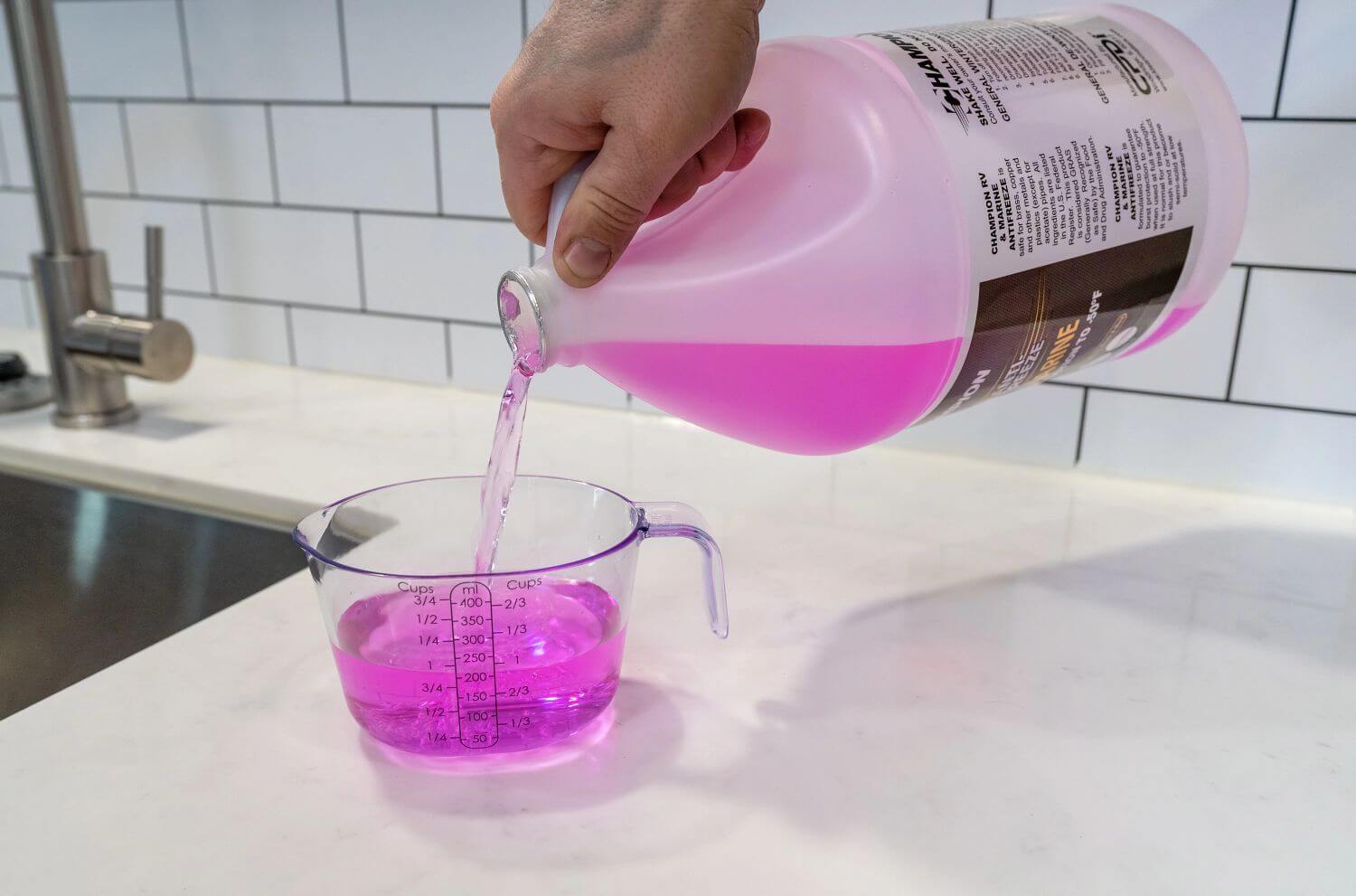
The recommended amount of RV antifreeze for your motorhome or trailer depends on its size. We generally recommend bypassing your water heater—and this is mainly because you’ll need a lot more antifreeze if you don’t.
Most RVs use roughly 2-4 gallons of RV antifreeze, including what goes down the sinks, to ensure any remaining water in the P-traps doesn’t freeze.
Component Definition: P-traps are the U-shaped sections of pipe beneath your sinks that hold water to prevent odors from your gray water holding tank from entering the cabin.
How Much RV Antifreeze to Put in Holding Tanks
Part of winterizing your RV is pouring antifreeze down the sinks to fill the P-traps. Naturally, this will result in some antifreeze traveling through your plumbing and into the gray water tank.
It is recommended that you pour 1-2 cups down each sink. Additionally, you can pour another 2-4 quarts into your RV toilet and then flush the toilet to leave a small amount in your black tank. This can prevent the freezing of residual waste and save you from having to fix a clogged black tank in the spring.
Adding antifreeze to your black water tank isn’t required, but it can prevent leftover tank waste from freezing and damaging the tank. Even if you frequently use your black tank flush to clean your tank as thoroughly as possible, RV holding tanks almost always hold residual waste. A little PG in the toilet and black tank helps prevent the seals from drying out while in storage, too.
Need a refresher? How to Flush RV Black Tank
How To Get Antifreeze Into RV Lines
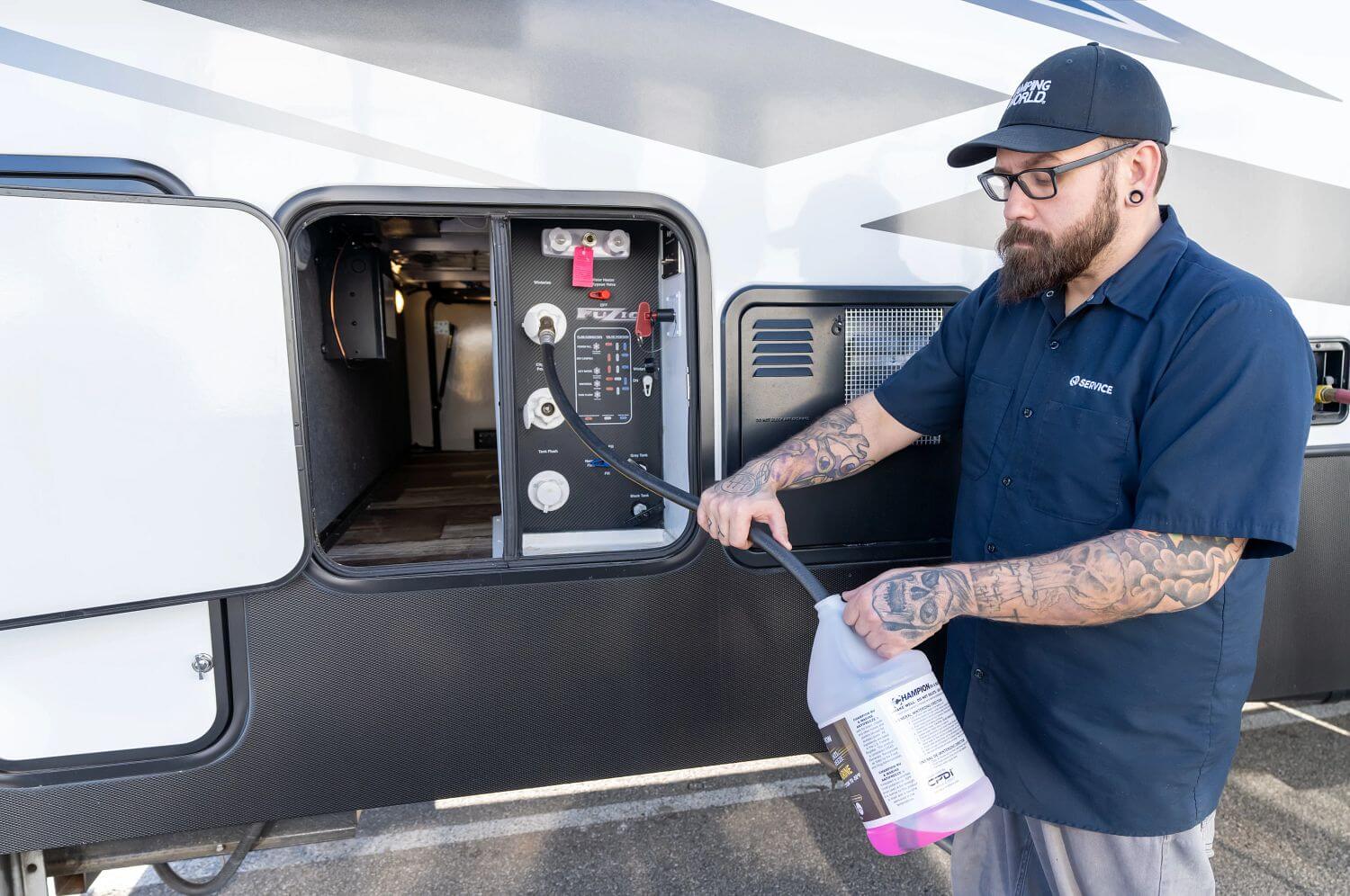
When your RV is winterized at a Camping World Service Center, your trained technician will utilize the T-valve before your water pump and connect a hose to pull antifreeze from the bottle into your RV’s plumbing lines.
You can do this by adding a water pump bypass or disconnecting the line to the pump and connecting a three-foot hose. You’ll need the proper fitting to connect the hose to the pump, and then you can insert the other end of the hose into your bottle of antifreeze to pump it through the system. Before pumping through the system, ensure your water heater is effectively bypassed.
Be sure to read and follow the winterizing directions for your specific water heater, as there are so many different types.
We don’t recommend adding antifreeze to your fresh water tank because it can require up to 10 gallons before the pump can pick it up, especially if your tank has a side pickup. The antifreeze will need to completely cover the pickup opening to keep the pump from sucking air. You’ll also need to spend a lot of time flushing the fresh water tank when de-winterizing your RV to get it to stop foaming at the faucets and to eliminate the smell and taste of antifreeze from the system.
Technician’s Tip: To ensure the PG isn’t diluted in terms of strength and temperature protection limits, it is essential to remove as much water from the system as possible before pumping the PG through it. We recommend using compressed air regulated to 30-40 PSI, and opening one side of each faucet at a time until no water or vapor is visible. If you are not equipped to do this, you can open the low-point drains and every single faucet indoors and out until gravity has pulled out as much water as it can. Then close it all back up and begin pumping the PG through one side of each faucet at a time until the entire system is protected.
How To Flush Antifreeze Out of an RV
Once you’ve winterized your RV, you’ll have antifreeze throughout your plumbing lines, in the P-traps, and a small amount in each of your holding tanks. Before you can safely use your RV’s water system for showering, washing dishes, and drinking, you’ll need to flush all traces of antifreeze.
Here are the quick steps to flushing RV antifreeze:
- Position your RV near a sewer connection and connect your sewer hose.
- Connect a potable water hose to your fresh water inlet and fill your fresh water tank.
- Turn on your water pump to pressurize the system.
- Open each sink and shower fixture one at a time to run water through your system and into the gray water tank. You can also depress the pedal on your RV toilet to run water through your toilet’s plumbing and into the black tank.
- Open all outside showers and low-point drains to let them run until clear water comes out.
- When your gray tank reaches two-thirds capacity, turn off all fixtures and shut down the water pump.
- Go outside and open the tank valves to drain your holding tanks (black, then gray).
- Repeat this process at least 2-3 times, allowing the system to sit and soak between each, until the water coming out of your fixtures is clear and completely free of any colored residue that matches the original color of your antifreeze.
Additionally, here’s another refresher on RV fresh tank sanitization.
How To Dispose of RV Antifreeze
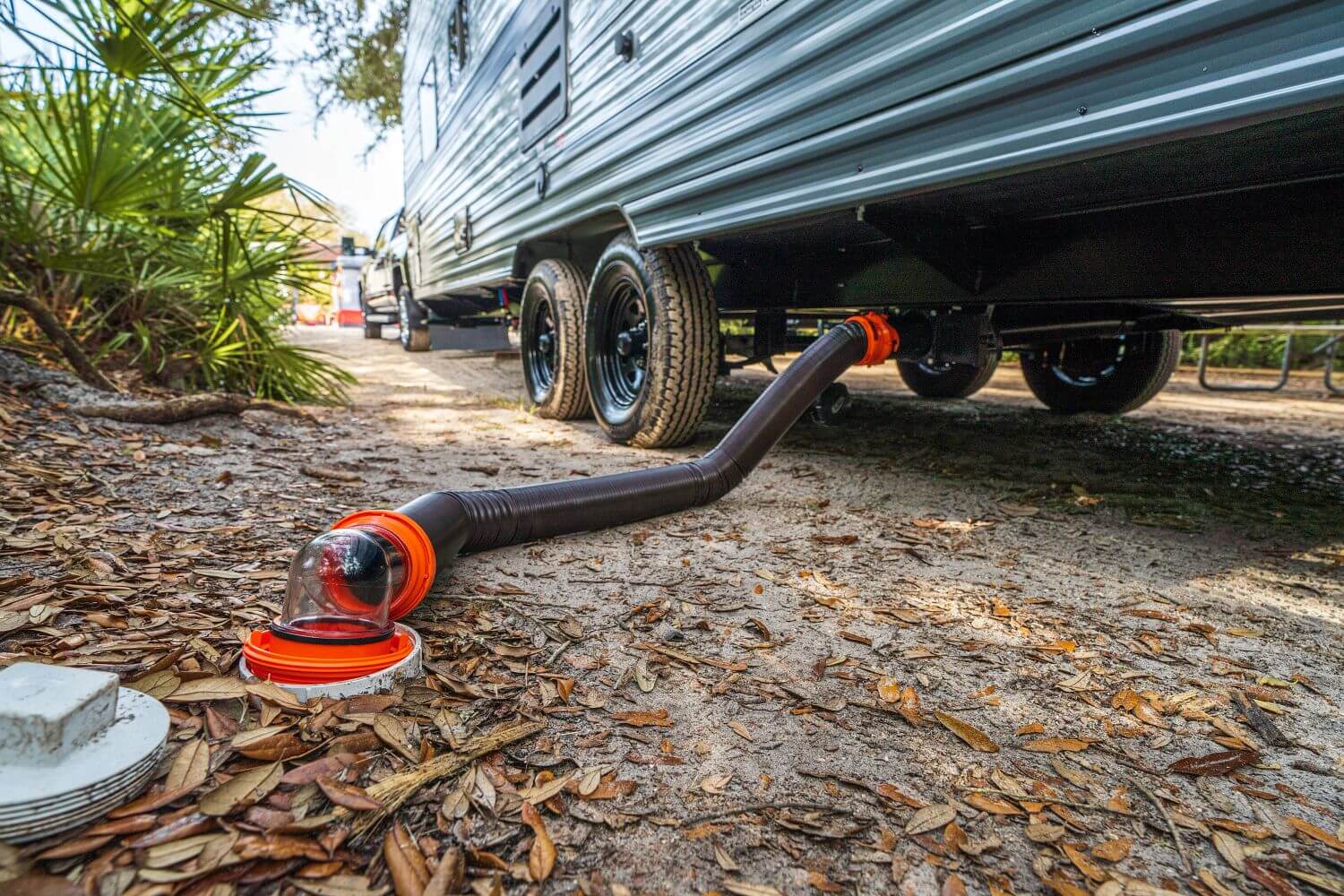
Sure, RV antifreeze isn’t toxic for your RV’s plumbing, but you shouldn’t dump it on the ground when flushing your system in the spring. Even antifreeze products labeled ‘biodegradable’ should be properly drained into a dump station, septic tank, or residential sewer clean-out.
Please note that non-toxic to humans doesn’t necessarily mean something is non-toxic to other creatures. If any PG is spilled, dilute and rinse it thoroughly with a garden hose.
Automotive antifreeze (EG) is very sweet-tasting and aromatic, and will readily attract dogs, cats, and other animals. However, it is deadly to animals. This should be bottled and taken to your community waste collection center immediately. Some automotive service centers will often accept waste antifreeze and oil. If EG is spilled, extreme care must be taken to clean it up and leave no trace behind.
If you cannot move your RV to dispose of antifreeze in one of these locations, you may also empty it into a portable RV waste tank. You’ll then need to transport that tank to one of the aforementioned locations to dispose of it properly.
Does RV Antifreeze Evaporate?
RV antifreeze does evaporate, but at a much slower rate than water. This is one reason it effectively protects your RV’s plumbing for an extended period. PG in the water lines of a winterized RV will last for years if necessary.
Under the right conditions, however, the antifreeze will evaporate. The first condition is that the antifreeze temperature rises above 223℉—although this is not impossible, it is highly unlikely during winter RV storage.
The second condition is that antifreeze is mixed with water to achieve a 50/50 ratio. This is not recommended for winterizing your RV, but the effect will be a diluted solution that evaporates more slowly than water but more quickly than an undiluted solution.
Does RV Antifreeze Go Bad?
Most RV antifreeze lasts anywhere from 1 to 4 years once opened. Depending on your product choice, your bottle(s) may or may not be labeled with an expiration date. If yours aren’t, a simple test is to shake the bottle and observe the liquid inside. If bubbles appear, your antifreeze has expired.
Here are some tips to maximize your RV antifreeze’s shelf life:
- Only open bottles when you’re ready to use them for winterization.
- Store RV antifreeze in a cool, dry, shaded location.
- Avoid leaving it outside in direct sunlight, especially when temperatures exceed 50℉.
Can You Use RV Antifreeze in a Car or Truck?
No, RV antifreeze and the recommended antifreeze for your automotive are not interchangeable. You shouldn’t use RV antifreeze in an automotive, and you can’t use the same antifreeze you use for your automotive to winterize your RV.
This is because RV antifreeze is specifically designed for use in your plumbing system, while automotive antifreeze is intended for use in the engine. Automotives usually require ethanol-based antifreeze (or an ethylene glycol base), which is toxic and should never be used in your RV’s fresh water system.
If you have a motorhome, you’ll need separate antifreeze solutions for your engine and the RV’s plumbing. The bottom line – find an antifreeze recommended by your automotive manufacturer and use a less toxic propylene glycol antifreeze to keep your RV’s plumbing lines safe during the winter.
Where to Buy RV Antifreeze
Find your nearest Camping World location to pick up RV antifreeze before it’s time to winterize again. Our recommended product is the Champion RV & Marine Antifreeze, but you’ll also need several additional products if it’s your first time winterizing your camper. Use the links below to shop for antifreeze and build your personal winterization kit.
Use these additional resources to protect your RV (and its plumbing) from extreme temperatures:
- Winter RV Skirting Tips
- Complete Guide to Winter RV Camping
- Do You Need Covers for RV Tires?
- Choosing an RV Cover for Your Camper
Do you have any other questions about RV antifreeze or its use? Share them in the comments below!



Question? While I put the anti freeze thru my rv lines do I need to close all my tanks? Please advise tks
Hi Brian! The short answer is that holding tanks should be closed when winterizing your RV. Thus, a small amount of antifreeze will end up in each tank. Here’s our full guide to RV winterization: https://blog.campingworld.com/learn-to-rv/how-to-winterize-your-rv/
Hi there! I install backyard sump pumps in Michigan. I use 3/4″ hose encased in PVC that runs to a pop-up cap to the front yard. The water freezes inside the hose in the winter. Would RV antifreeze work for this application? I thought if I ran the fluid through, the fluid would sit in the low spots of the hose where the water would freeze.
Thanks!!
Hi Brent!
My gut says that it may, but contacting the sump pump manufacturer to get their recommendation would likely be the safest bet.
a friend gave me 55gallon drums of used RV antifreeze out of his wood stove, said it was only a couple of years old, it is not pink anymore. I was going to use it to winterize my sprayers. I put some in a jar and placed in the freezer, it turned to hard slush. I have freezer set to -6 F. Do I dare use it? I am from central Minnesota. Richard
Hi Richard,
Your best bet is to purchase new RV antifreeze. I think your test confirms your suspicions about using this used solution!
We winterized our building with your product but have in floor heat on at 50 degrees. We have a chemical odor in the building we are trying to understand. Could the problem be the antifreeze in the traps being warmed?
Hi Mark,
This product does have a sweet smelling odor from the propylene glycol and surfactants… basically alcohol and soap. For safety’s sake, you should have a professional inspector rule out anything else.
Hope that helps!
Tucker, if the RV anti-freeze is a mix of propylene gylcol and alcohol, and we put it in the P traps in our RV, (and toilet in our vacation cabin), will the alcohol evaporate and make it less effective? It had a surprisingly strong alcohol smell, so I assume the alcohol is evaporating fairly quickly. In such open systems, would we be wiser to use RV anti-freeze with only proylene glycol and no alcohol?
Hi David,
I’ve always used a propylene glycol solution like this Champion camper antifreeze and never had any issue.
That’s the product I’d recommend for winterizing your RV’s plumbing lines. Your vacation cabin may require something different, so I can’t speak to that. But hope that helps!
Hello Tucker…your article is a few months old but hoping you might still see this and reply….
We just attempted winterizing our Jayco 5th wheel (has the “dock station”) and even though we checked and double checked to make sure the valves were all in the winterize position, we had antifreeze pouring out our hot water tank (rod was removed). While it was the first time this year we’ve winterized this unit, it’s not the first time ever and we don’t recall this happening before 🤔. Did we miss a step somewhere or is something amiss?? Thanks in advance for any help/advice!
Hi CJ!
I’d recommend contacting one of our service centers to speak with an advisor. It could be that your water heater bypass is installed in reverse, but short of testing to see if you get antifreeze through the tank while the switch is in the other position, you’re likely best speaking with an advisor.
Here’s a link to help you locate the service center nearest you: https://rv.campingworld.com/rv-service-maintenance
Let us know if you have any other questions!
Is the antifreeze you’re discussing a freeze point at -50° or a bursting point at -50°? Most RV antifreeze that is -50° burst proof actually freezes somewhere between +16°F – +20°F. Thanks.
Hi Bear,
Are you referring to the Champion antifreeze mentioned in the final section?
That manufacturer does claim Burst Protection down to -50°F.
Is Champion pool antifreeze fully dispersible, meaning will it mix fully with any water left in a line. I read that RV antifreeze is fully soluble but not sure if that is the same.
Also, I made the mistake of back filling the inlet side of the pool pump with Champion RV antifreeze but then drained it out and flushed it with water after realizing my mistake. It was left in 3 days. Will this cause damage to rubber seals and metal in the pump?
Thanks
Hi Steven,
I just want to understand your question a bit better.
When you say ‘pool pump’, are you referring to your RV’s water pump? Or a separate pump you’re using to pump antifreeze into your RV’s plumbing? And how did you go about back-filling it?
Looking forward to your reply!
Do I need to “blow out” the water lines before I use anti freeze? I have seen other recommendations to do that step first – thanks the video was helpful.
Hi Tom,
Yes, we do recommend that step…if you have access to compressed air and have the proper device need to regulate air pressure to avoid damaging your lines. If not, all of our service centers offer Basic and Upgraded Winterization packages to do this properly for you. Here’s a link to our tutorial on winterization: https://blog.campingworld.com/learn-to-rv/how-to-winterize-your-rv/
And another link to help you find service centers near you: https://rv.campingworld.com/rv-service-maintenance#js-anchor-locations
Is antifreeze safe on acrylic shower floor
Hi Darcie,
Propylene Glycol, or RV Antifreeze, is non-toxic and will not destroy plastics, but it probably will result in permanent staining if not cleaned up quickly. Having antifreeze drip from faucets is normal as temperatures fluctuate or the RV is moved around, so it’s best to open the low point drains and faucets after winterizing to draw the antifreeze away from the outlet of the faucets. Shower wands should be disconnected, blown out, and reinstalled as well.
Informative article, however it does not address the issue of which type antifreeze to use.
Is Alcholol/propylene glycol better than straight propylene glycol products. Does alcholol blends degrade rubber seals in plumbing systems?
Hi Jan!
Propylene Glycol is alcohol. It is a non-toxic product that is safe for use in potable water systems. Ethylene Glycol is also an alcohol and is used to make automotive antifreeze. Unlike Propylene Glycol, Ethylene Glycol is extremely toxic if ingested and should never be used in potable water systems. Both types come in different brands, colors, and concentrations, but the customer need only determine if they require non-toxic and to what temperature it must protect to. In short, yes, alcohols can degrade rubber seals over time, but RV antifreezes are considered safe and stable within the plumbing pipes for 2 to 5 years.
Let us know if you have any follow up questions!
Tucker there are 3 types of antifreeze. The type used in an automobile engine, ethylene glycol which is poison and is never meant for winterization but then there are the 2 types that are suitable for potable water, ethanol based and propylene glycol based. Propylene glycol is not alcohol, it is suitable for winterizing potable water and marine raw water cooled engines. The Ethanol based is only suitable for potable water and is half the price of the propylene based. Jan is asking if the cheap stuff , alcohol based, will degrade rubber in fresh water systems like in the water pump or toilet seals. If so, then what is it suitable for?
Hi Tim,
I’ve utilized Champion RV Antifreeze in my trailer, without any issue. But I never leave it in my system for more than a few months at a time, although it’s rated to be safe and stable in RV plumbing for 2-5 years.
I’ll inquire further with our technical service team to see if I can get more information!
If I am using my travel trailer during the winter how do I protect the water system from freezing? If the interior is kept warm, will this keep water system from freezing? Will be camping in temperatures from 20 degrees farenheight and up.
Will not have access to water source other than holding tank and need water for interior use; sinks and shower
Hi William,
Winter RV camping is a challenge, but it’ll be much easier if your trailer is built for four-season use. What make and model do you have?
I once spent a winter in an older Fleetwood Bounder in my hometown of Truckee, CA. Here are a few things I did that helped:
1. Enclosed the underbelly. Many RVers use foam board insulation for this, and the thickness you’ll need depends on the average low temperatures in your area.
2. Add a holding tank heating pad. They’re the best way to keep your tank’s contents from freezing. Some RVs are built with these.
2. Utilize a heated drinking water hose. I purchased this Camco product, which requires 120VAC power and worked great for us: https://www.campingworld.com/camco-freeze-ban-heated-drinking-water-hose-630040.html
3. Supplement your RV’s furnace with a RV space heater. Here are a few articles on the considerations for choosing an RV space heater and managing the extra moisture/condensation they can create inside your RV:
https://blog.campingworld.com/gear-and-accessories/different-types-of-space-heaters-for-rvs/
https://blog.campingworld.com/learn-to-rv/keeping-moisture-out-of-your-camper-and-why-its-important/
4. Research local propane companies and consider connecting to an external tank. We had a 120-gallon tank delivered and hooked up to our motorhome’s onboard ASME propane tank. The service also offered an auto-refill, which we took advantage of to ensure we never ran out of propane for cooking and heating our RV. Of course, it’ll be easier for you with the removable propane containers on your travel trailer, but ensuring you always have a backup is a smart idea.
I hope these ideas help, but feel free to reach out if you have any follow up questions!
Can I leave last year’s anti freeze in my motor home for another year?
Hi Larry,
When sealed within the RVs pipes and faucets, RV antifreeze should be fine for 2-5 years depending on the ambient temperatures. If it is in the P-traps or toilet bowl, it will evaporate and become syrup like in less than a year.
Hope that helps!
We just bought a 2018 pioneer Rd210 from camping world in Albany ny.
Love it. But have not been able to use hot water yet since it smells like hairspray!
I am on oxygen.I read this article and it seems to say no antifreeze in fresh water, so what is this smell from my water heater? Not in Albany but Kingston ny. I am camping in Georgia.
Hi Camille,
Sorry for the delayed response, but I wanted to reach out to our technical service team to get their thoughts. Here’s their reply:
Water heaters should never have antifreeze in them, true, but that doesn’t mean it didn’t happen. Also, water heaters should be flushed once per season and failure to do so can result in foul odors in the water. RV water systems should be sanitized with a bleach solution before use, and if this was done to this unit the freshwater could still carry some bleach scent. With locations in Georgia, it would be prudent to visit a CW location for a courtesy inspection.
Here’s a link where you can find the nearest service center to you: https://rv.campingworld.com/rv-service-maintenance#js-anchor-locations
And one more link on the specifics of sanitizing your fresh water system: https://blog.campingworld.com/learn-to-rv/sanitize-your-rvs-freshwater-system-in-5-simple-steps/
Hope that helps!
RV antifreeze and a regular antifreeze are different products with distinct roles for each vehicles, so don’t use an RV antifreeze for your car.
Is it ok to leave rv antifreeze in rv lines for over a year ?
Hey Jack,
Most RV antifreeze has a shelf life of 1-4 years, but that is when kept in its original sealed container. Still, RV antifreeze contained within the water lines of your RV is stable for very long periods of time. Any that is exposed to the air will gum up.
Hope that helps!
Great help but my question is why no one talks about seniors an handicap issues how to make things simply accessible for all us old poops that need this?
Seems we are not included in easy methods for us physically challenged seniors !
Hi Rox!
This is great feedback, and I look forward to incorporating it as we strive to better serve you! In the immediate future, is there anything specific to RV winterization or using antifreeze that you’d like to see more accessible solutions for?
Our service centers are also a great resource if you’re struggling with anything related to seasonal RV maintenance: https://rv.campingworld.com/service
I hope that helps and look forward to hearing back from you!