
Think of your RV wheel bearings as the unsung heroes of your road trip. While they are tucked away inside your wheel hubs, they carry the entire weight of your home-on-wheels while allowing your tires to spin at 60+ mph.
Maintaining them is a messy job, but neglecting them is far worse. Failing to regularly grease camper wheel bearings can increase friction, leading to overheating, premature tire failure, or, in the worst-case scenario, a seized axle.
In this guide, we’ll cover exactly how often to grease trailer bearings, the signs of wear to watch for, and how to keep your travels rolling smoothly.
Key Takeaways
- Maintenance Frequency: Most RV wheel bearings are unsealed and require cleaning and repacking with grease at least once a year or every 10,000–12,000 miles to prevent axle failure.
- Warning Signs: Critical indicators of bearing wear include grease splattering on the rims, grinding or chirping noises, excessive hub heat, and physical “play” or movement in the wheel.
- Safety and Inspection: Regular servicing prevents dangerous wheel seizures and provides professionals with an opportunity to inspect related components, such as spindles and brakes.
What Are RV Wheel Bearings?
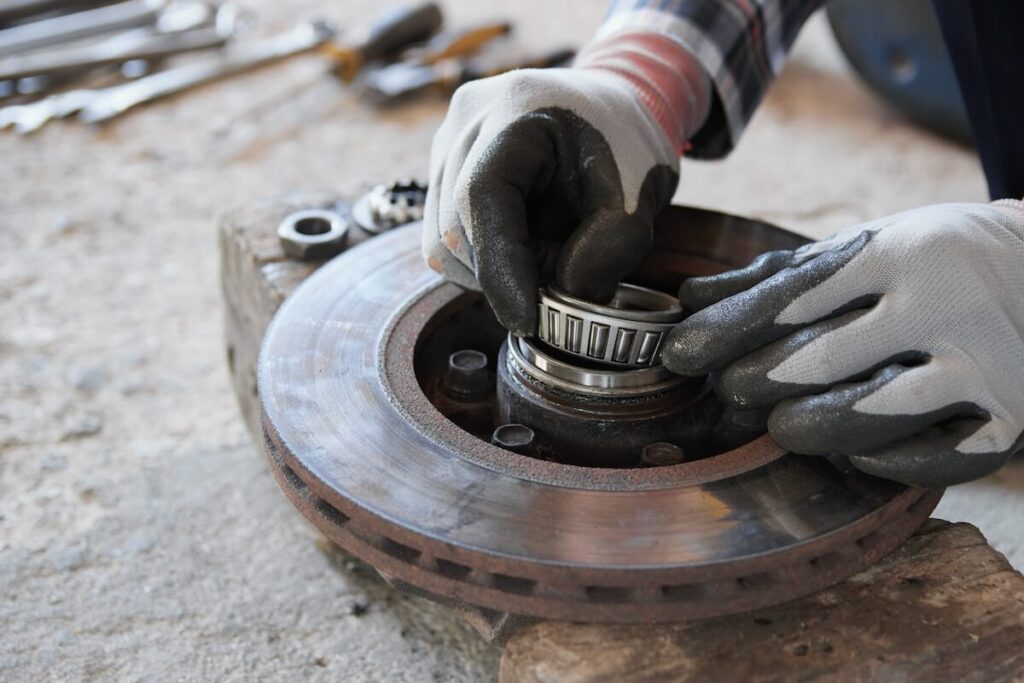
Your wheel bearings are located inside the hub of your RV wheels. They are a set of small steel rollers in a metal ring (called a cage) that allow the wheels to spin with minimal friction.
One of the best ways to protect your bearings is to understand your trailer ratings for cargo capacity and other important metrics and never exceed them. Excessive weight puts undue stress on the bearings, causing them to heat up and wear out prematurely.
Sealed vs Unsealed Wheel Bearings
Some modern vehicles use sealed bearings. This design traps the grease inside and prevents debris from entering. Sealed bearings do not need to be cleaned and repacked.
However, you’ll find unsealed bearings on almost all standard travel trailers and motorhomes. These require specialized wheel bearing grease to reduce friction and must be cleaned and repacked with fresh grease at regular intervals to prevent failure.
Why Wheel Bearing Maintenance Is Critical for Safety
Over time, the grease inside unsealed bearings breaks down due to heat and age. It can also accumulate road grit and debris. When your RV sits idle for months, the oils in the grease can separate from the carrier media and leak past the seals. This oil typically ends up in the brake drum, increasing stopping distances and requiring brake replacement.
Whether it’s due to leakage, aging, or debris accumulation, if wheel bearing grease isn’t replaced regularly, the increased friction and heat will lead to premature failure. That frictional heating can also cause a fire that damages your RV.
If a wheel seizes while you’re traveling at highway speeds, it puts you and everyone around you at risk. Even at low speeds, a failed bearing usually results in expensive roadside assistance and axle repairs that far exceed the cost of simple preventative maintenance.
Technician Tip:To stay ahead of issues, keep up with these RV preventative maintenance tips.
How Often Should You Grease RV Wheel Bearings?

This is the most common question RVers ask. While you should always start by referring to your specific RV manufacturer’s specifications, there is a general industry standard for travel trailers and motorhomes.
| Usage Type | Recommended Interval |
| Standard Use | Once a year or every 10,000 to 12,000 miles |
| Frequent/Full-Time Travel | Every 6 months or 6,000 miles |
| Occasional/Short Trips | Once a year or every 2,000 miles |
Why the Yearly Rule?
Even if you take only a few short trips each year, the grease in your bearings can break down or separate over time. While the best RV wheel covers can reduce the amount of moisture and debris that enters the hub while parked, they don’t stop the chemical breakdown of the grease.
Note for New RV Owners: If you’ve recently acquired a new or used motorhome, have a certified RV technician inspect your wheel bearings before your first trip. Unless you have a dated service receipt, it’s best to start your ownership with a fresh repack. This is also the ideal time to have your tech inspect, clean, and adjust your brakes.
Four Signs Your Wheel Bearings Need Service

Sticking to your RV manufacturer’s recommended service intervals is the best way to stay safe, but you can also stay vigilant for these common warning signs of camper wheel bearing failure.
Visual Signs (Grease Splatter)
If you see an oily film or grease “splattering” onto your rims or coming out of the hub, it’s a sign that a seal has failed. Once the seal is gone, the grease will quickly leak out, leaving the bearing bone-dry.
Audible Clues (Chirping or Grinding)
If you hear a high-pitched screeching, “chirping,” or a rhythmic grinding sound coming from your wheels while in motion, your bearings are likely metal-on-metal. This is an emergency—stop as soon as it’s safe to do so.
The Physical “Play” Test
If you can safely jack up your RV so the tires are off the ground, grab the tire at the 12 and 6 o’clock positions. Try to rock it back and forth. Repeat this test with your hands at the 3 and 9 o’clock positions. The tire should have almost zero movement on the axle. If you feel a “clunk” or significant play, the bearings are worn, or the spindle nut is loose.
Technician Tip: Lifting an RV to perform this test requires a heavy-duty floor jack and jack stands. Only attempt it if you have experience doing this safely, your floor jack is properly rated to handle your RV’s weight, and you know what you’re feeling for in terms of bearing play.
Excessive Heat
A practical test during a road trip is to (carefully!) feel your wheel hubs during a fuel stop. They should be warm to the touch, but never hot. If one hub is significantly hotter than the others, that’s a sign that your bearings need immediate attention.
Technician Tip: Non-contact IR thermometers are a much safer and far more accurate way to inspect wheel hubs for excessive heat. They are inexpensive, readily available, and useful for checking the temperature of cookware, HVAC, and other RV components.
Professional vs DIY: Which is Right for You?
Cleaning and repacking RV wheel bearings is a DIY task for many owners, but it is notoriously messy and requires specialized tools such as heavy-duty floor jacks, torque wrenches, and bearing packers.
If you want to save time, cleanup, and grease under your fingernails, we recommend having a professional handle the job. A certified technician won’t just grease the bearings—they will also inspect the spindles for heat damage and ensure your brakes are in top shape.
Ready to DIY? Check out our Step-by-Step Guide on How To Grease RV Wheel Bearings.
Technician Tip: Keep in mind that axle and hub issues can be complex. If you suspect issues you aren’t comfortable troubleshooting, schedule an appointment at your closest service center for further inspection.
Here are some additional RV maintenance resources:
When was the last time you had your RV wheel bearings greased? Leave a comment below.



Many years ago I made my living as a heavy equipment mechanic – primarily agricultural equipment – but I also worked on lots of over-the-road truck-tractors, straight trucks, cars, pick-ups, etc. On occasion, some piece of equipment would come into the shop where I was working with a failed wheel bearing but it wasn’t common. Back then, the ‘rule of thumb’ was to grease wheel bearings when you did a brake job, often around 30,000 miles or so – if someone mainly drove on the freeway, they could easily go 60,000 miles before they would need new brakes, however, that still didn’t cause more frequent failure of the wheel bearings, despite the long interval between being packed. I’m relatively new to RVing and, frankly, I don’t understand why wheel bearings on travel trailers need to be repacked so often – it doesn’t make sense. Nor can anyone explain why trailer manufacturers haven’t switched to ‘lubed-for-life’ bearings that don’t need to be repacked – they started using those in cars almost 60 years ago. Granted, repacking tapered roller bearings is a simple procedure and the cost of the grease and seals are negligible but every 12,000 miles? Is this just the trailer manufacturer (or the axle manufacturer) trying to minimize their exposure to liability?
The trailer my wife and I just purchased had been used once and has very few miles on it. Regardless, I just pulled the drums off and repacked the wheel bearings. Go figure.
Safe travels.
Great question here, and it requires a bit of history to address. We reached out to our technical service team for their insights, which they graciously provided below:
Several years ago, manufacturers advised packing bearings and replacing the seals every 4 years. But, like manufacturers do, they tend to adapt their policies to match market experiences, and in this case, they saw an ever-increasing number of bearing failures. They steadily reduced the time period between bearing services until they reached the once-per-year or every 12,000 miles that is currently a common standard.
The bearings were not the cause of the failures, but rather the nature of RV use which sees them spending most of their lives parked. The fluid lubricant would simply leech out past the seals leaving the carrier medium behind. The bearings would then overheat due to the lack of lubrication and fail. Another cause of failure was the advent of greaseable hub caps and spindles. In that case, many Rv owners took the “more-is-better” approach and as a result would blow out the inner seal and the grease ended up in the brake drums instead of the bearings. On the surface, once annually or every 12,000 miles (whichever comes first) does seem to be overkill, but it is a quick and affordable practice that prevents more costly and dangerous failures.
As to the question of why the manufacturers haven’t adopted lifetime sealed bearings, they actually did some time ago. The Nev-R-Lub brand is a common option, and even standard on some RVs from the OEMs. Upgrade kits from various aftermarket sources are also available which consist of sealed bearings to replace the existing bearing and race system all the way up to complete axle assemblies.
Options exist for unique requirements, whether it be service or parts, OEM options, or aftermarket upgrades. But something to keep in mind when weighing the expense of a service is that repairs will always cost a lot more than maintenance.
Hope that adds some context and is helpful. But please let us know if you have any questions!
Great info
Glad you found it useful!
When your pumping in the grease n you don’t see the old grease coming out. What’s wrong ?
With a larger travel trailer, you should grease your trailer wheel bearings every 10,000 miles or once a year
Once you are on the side of the freeway changing wheel bearings, you get learned up fast!
I use that sticky red grease, the kind that sticks to everything ten feet away.
I also stay away from Chinese made bearings. I have had those burn up within 4000 miles. I like Timkins made in the USA.
We use our RV fairly hard, and do many dirt roads also. Dirt roads, for what it’s worth, I would cut the regrease time in half if you do dirt roads often, 5000 miles. I just changed my bearings, if I see any issues, such as the grease is runny and black (indication of bearing wear), I just put in new bearings. Trust me on this, it isn’t worth the cost and angst of roadside repairs. for $20 a wheel. And when you burn up the spindle, you need welder work done to replace the spindle, or the whole axle replaced.
I always carry a full set of spare bearings in the RV. Along with a good hammer, a drift (to remove the races) and I bought a bearing race driver kit, it wasn’t much money, but makes changing bearing races much easier. I also use one of those cone shaped bearing greaser devices that pushes grease through the bearings, you use a grease gun. I keep a thread die in my tool kit to clean up the threads on the bearing spindle. Once the spindle is gone, break out your wallet. Sometimes a fine flat bastard file is needed to clean up the spindle. Keep a can of brake cleaner along, makes cleaning parts easier when you don’t have compressed air while on the side of the road.
I also avoid using the grease zerks seen on Dexter axles. Grease will end up pushing past the seals, onto the brakes, rendering those useless. If you do use the zerks, jack up the wheel, and rotate the wheel and give two slow strokes.
Regreasing your bearings is not a difficult job, and can be done in a day. Always replace the seals when regreasing, they are cheap and non-reusable. A tub of solvent with a stiff paint brush along with compressed air and a air nozzle is needed to totally clean things up proper.
My wife and I did a 14.5k mile trip last year, Alaska to Florida and back, it took ten weeks. I had two bearings burn up. I was able to do repairs on the side of the road, because I keep spare parts and tools handy. The second bearing that failed was replaced mid trip with made in China bearings, they are made with inferior metals and wear quickly. Avoid! RV part houses sell those, you can tell, if it’s hanging on a rack do not buy. If the new bearings come wrapped in a little box, with a name like Timken, FAG, National Bearing, etc, you’re good to go.
Check for black runny grease and that smell of heat when removing the bearing cap. If you see black grease when red grease was used, the black is from metal wear, you must regrease. At that point, I’ll replace the bearings. Why mess around for about $20 a wheel?
I never go anywhere without a full kit of bearings, seals, and grease. I also keep new caps, washers, nuts, and retainers in my “kit”. Those small parts just about always get wasted when a bearing goes out. Another handy thing to keep is a new wheel hub, already packed with grease and new bearings. This would work for braking or non braking axles, unless you packed a hub with brake drum. But those are heavy and take up space, a non-braking hub isn’t big or heavy, but would help to get you back on the road to somewhere better then the side of I-70! Just turn your brake controller to zero and slow down.
Those Timken bearings that have USA stamped on the are actually made in China. The stamping of USA signifies they are a US based company but that L44649 bearing is not made in US. The problem is not China. The problem is the use of inferior metals and that is not specific to China.
what about sealed wheel bearings
I grease my RV wheel bearings about every 7500 miles
I’m glad to know that greasing the wheel bearings will help the travel trailer to spin freely and easily. My brother is taking his family camping this weekend, and I don’t think he’s ever greased the bearings. I’ll get him a grease gun so he can carry it in case he needs it.
Great advice from this man, follow his instructions and you’ll be fine.
more often than recommended is never a bad thing
What grease do I need to use?