The gap between a travel trailer marketed as “off-road ready” and one that can actually handle backcountry terrain is wider than you might expect. Skid plates, independent suspension, reinforced frames, and serious off-grid power systems set the best off-road travel trailers for dispersed camping apart from those that barely handle a maintained gravel road.
Our guide to the best overland trailers in 2026 covers accessible overlanding rigs you can find at Camping World and purpose-built 4×4 trailers from specialty manufacturers. If you’re ready to leave hookups behind, here’s where to start.
Key Takeaways
- The best off-road travel trailer depends on your trip, not just your budget. Overlanding, boondocking, and true 4×4 capability ask different things of a trailer’s suspension, weight, and water capacity.
- CCC (Cargo Carrying Capacity) matters more off-road than on pavement. Washboard roads and rough trails are harder on an overloaded trailer than a smooth highway, so don’t just look at GVWR.
- Off-road campers are worth the money if you’re actually leaving maintained roads. If your idea of boondocking is a gravel BLM lot, you likely don’t need a trailer with a galvanized chassis and independent suspension.
Best Off-Road Travel Trailers for Overlanding
The best overland trailers of 2026 share a few things: real ground clearance, suspension that actually works off-pavement, and enough off-grid capacity to stay out for more than one night. Here are the ones worth your attention.
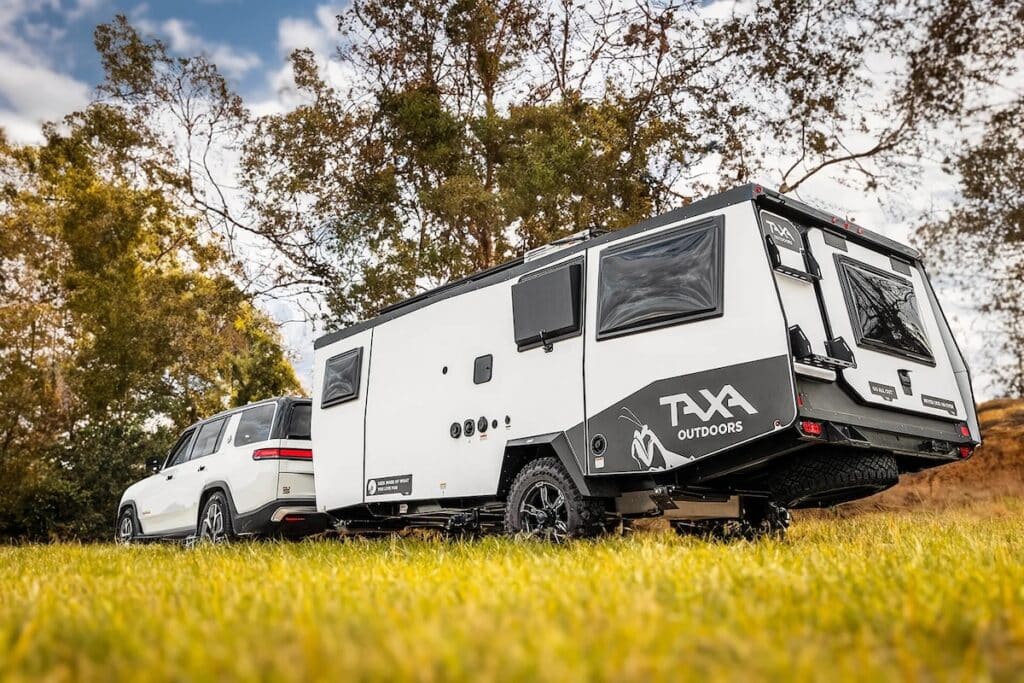
TAXA Outdoors Mantis Overland Edition
Specs
- Length: 19′
- Hitch Weight: 510 lbs
- GVWR: 5,000 lbs
- CCC: 1,614 lbs
- Sleeping Capacity: 4+ Adults
- Ground Clearance: 14”
The Mantis Overland Edition swaps TAXA’s standard axle for an axle-less suspension and adds real ground clearance, which is the difference between off-road styling and a trailer that can actually take a rutted trail. The Overland model increases ground clearance from a traditional 11” to 14”, giving you access to more off-road options. The pop up roof gets you standing height at camp while keeping a sleek, low-drag profile when in tow.
This is a practical, rugged travel trailer, so don’t expect all the amenities you’d find in a standard enclosed travel trailer. It comes standard with a cassette toilet and pop up wet bath, a convertible sofa-to-bed, and modest 20-gallon fresh water and 22-gallon gray water tanks.
For someone who’s willing to sacrifice small comforts for heavy-duty capabilities, the Mantis Overland is built specifically to perform in the most rugged conditions.
Ember Overland
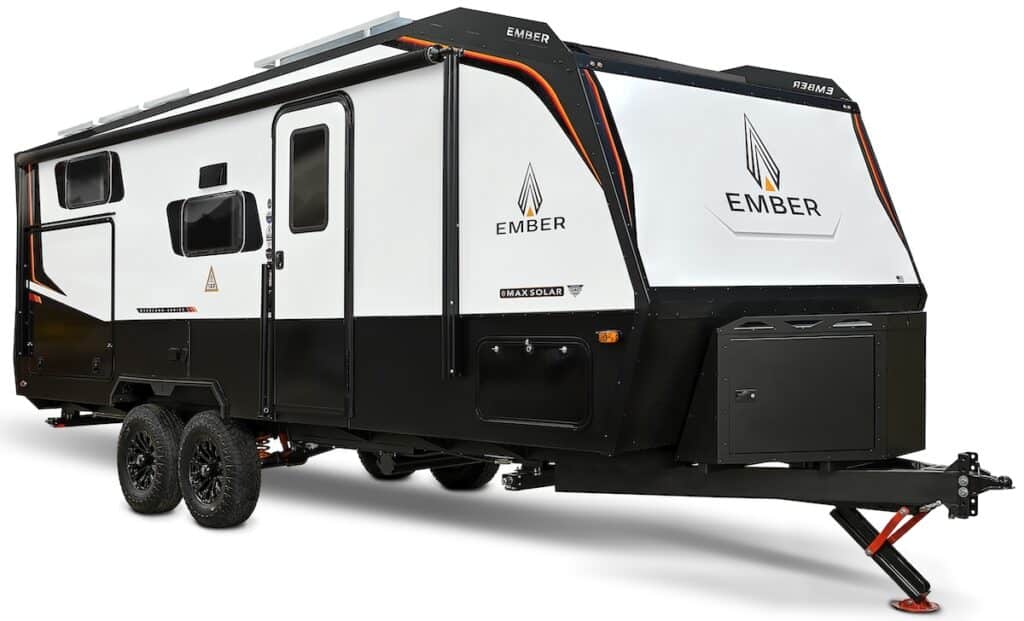
Ember launched in 2021 for people who want to tow off-road without stepping up to a full expedition rig. Every Overland floorplan rides on Ember’s Trailblazer off-road chassis with CURT® independent suspension, and every one comes standard with a full bathroom and an off-grid solar package. These rigs were purposely designed with Forest Service roads in mind.
Specs
- Length: 22’6″ to 28’3″
- Hitch Weight: 645 lbs to 895 lbs
- GVWR: 5,930 lbs to 9,995 lbs
- CCC: 985 lbs to 3,040 lbs
- Sleeping Capacity: 2 to 8
190MSL: A compact bunkhouse that converts to a gear garage with EmberTrack tie-downs to secure big items like e-bikes and kayaks. The jackknife sofa, queen Murphy bed, and convertible single and double bunk area mean you can sleep up to 8 in this rig.
191MSL: A step up from the 190MSL, this bunkhouse sleeps up to eight people in a travel trailer under 25 feet. What sets this one apart is the inclusion of a single off-camp slide.
201FBQ: The couple’s floorplan, with a walk-around queen bed and tandem-axle for extra stability on rough roads. Best for two people who want more room to move without stepping up to a full family layout.
221MSL: Another good option for larger groups, this bunkhouse is similar to the 191MSL but with a bit more length for added space to move around. The rotating side tables by the sofa provide great workstations when on the go.
240TKR: Ember’s heavy hitter, this is a great option for a couple or family who wants to work from the road. The front twin-to-king conversion provides a cozy place to relax, and the folding bar can be used as a desk or extra prep space when cooking.
Ember also has some retired floor plans that remain among the best used off-road travel trailers. The 191MDB is a carbon copy of the 191MLS, just listed under its original model code. And the 170MRB is the lightest and shortest Overland I’ve seen. This setup excludes the slide but still makes great use of the interior space, making it feel open and airy for couples or small families who don’t want to deal with the hassle of extra camp set-up.
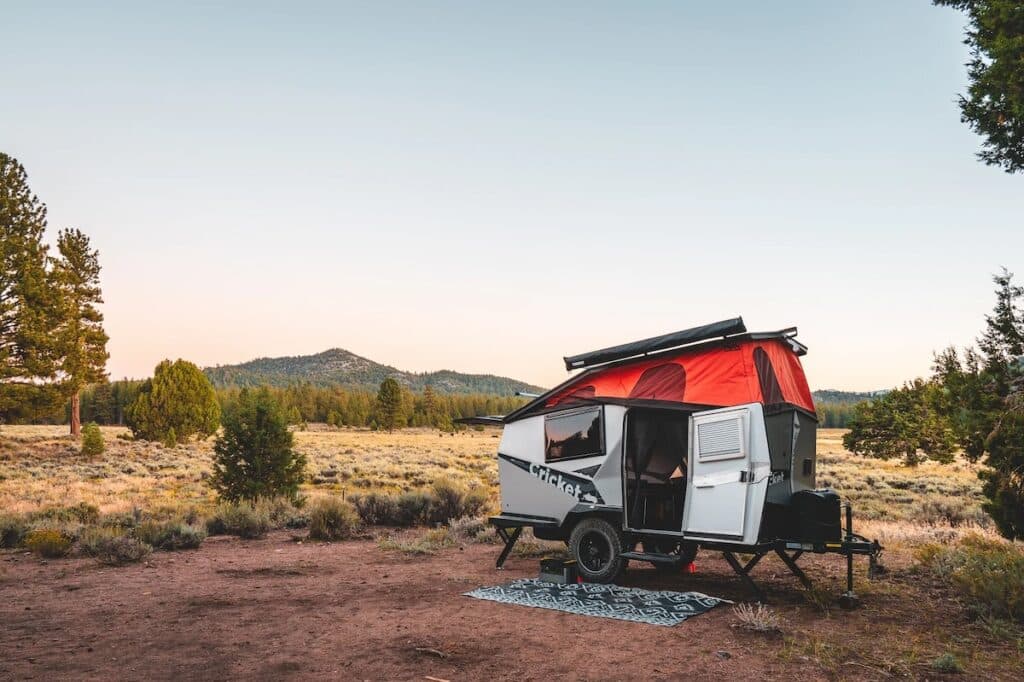
TAXA Outdoors Cricket Trek
Specs
- Length: 15′
- Hitch Weight: 245 to 264 lbs
- GVWR: 2,700 to 3,000 lbs
- CCC: 900 to 1,022 lbs
- Sleeping Capacity: Up to 4
- Ground Clearance: 11-14” (model dependent)
The Cricket Trek is TAXA’s entry point, and it proves that off-road capability doesn’t require a heavy or lengthy trailer. Most mid-size SUVs can tow it without strain, and the swing-up rear door makes loading gear almost too easy. Inside, you get a full bed, a two-burner stove, a covered sink, and enough milk-crate storage to stay organized on rough roads.
What you give up for that weight is plumbing: there’s no built-in bathroom on the Trek trim, just room for a portable cassette toilet and an exterior shower. For a solo camper or a couple prioritizing towability over comfort, that’s an easy trade.
For picks organized by weight rather than terrain capability, see our guide to the best lightweight travel trailers.
Best Travel Trailers for Boondocking
Boondocking is about how long you can stay off-grid: water capacity, battery capacity, and a bathroom you’re not sharing with the outdoors. The best travel trailer for boondocking doesn’t necessarily need off-road chops if you’re parking on a flat BLM lot, but the two picks below can do both.
If extended off-grid living — rather than trail capability — is your primary goal, our guide to the best travel trailers to live in full-time covers residential-grade systems and floor plans built for long-term comfort.
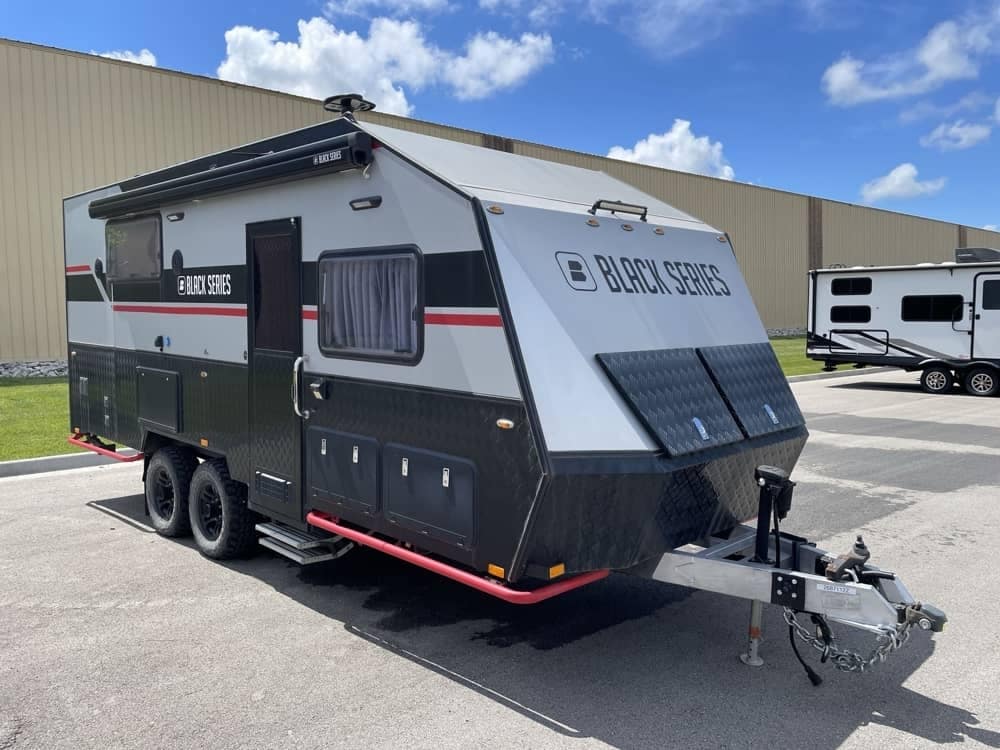
Black Series HQ19
Images by Camping World
Specs
- Length: 25′
- Hitch Weight: 652 lbs
- GVWR: 10,000 lbs
- CCC: 3,475 lbs
- Sleeping Capacity: Up to 3
- Ground Clearance: ~15-16”
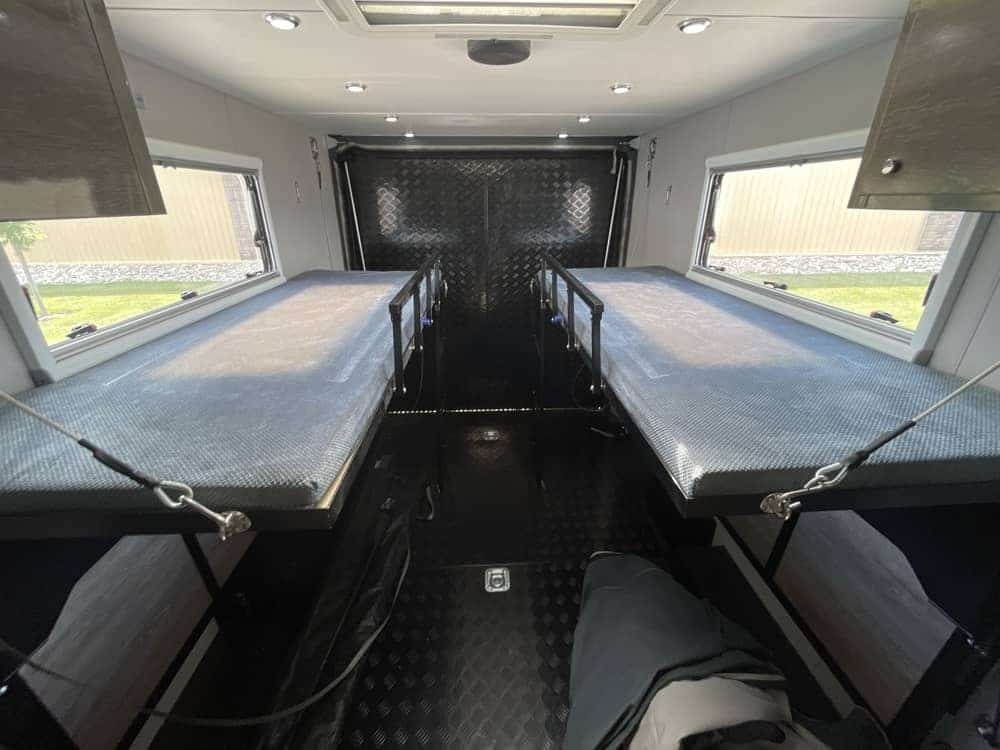
The HQ19 is the trailer people picture when they imagine a luxury off-road build: hot-dipped galvanized chassis (if you’re like me and had to look that up, it prevents corrosion), fully independent suspension, and a 64-gallon fresh water tank that supports extended off-grid time. The en-suite bathroom has a full fiberglass shower and a washing machine, which isn’t something you see on most trailers in this category, off-road or otherwise. The four 150W solar panels will keep the lights on long after you’ve left the pavement.
The tradeoff is weight and price. At a 10,000-pound GVWR, this needs a serious tow vehicle. But if you want the comfort of a luxury trailer with the chassis to leave the highway, this is a base-camp trailer built for people who want to park somewhere remote and stay there. It might not be a full-time living rig, but it’s one of the most capable off-grid setups you’ll find in a towable under 26 feet.
Rockwood Geo Pro G20FBS
Specs
- Length: 21′
- Hitch Weight: 435 lbs
- GVWR: 5,135 lbs
- CCC: 1,342 lbs
- Sleeping Capacity: Up to 2
- Ground Clearance: ~12-15”
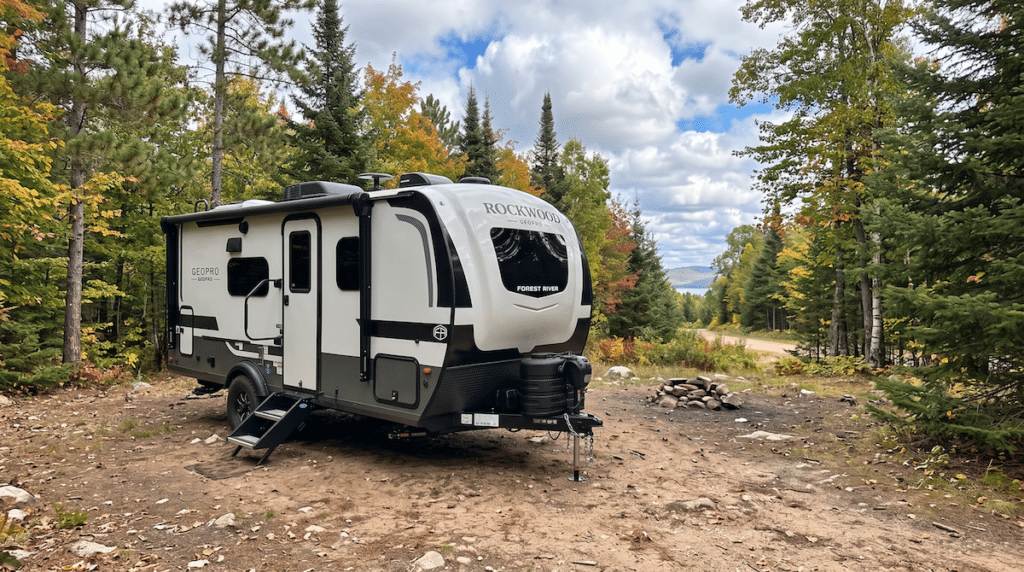
The G20FBS is built around a full walk-around bed and a large rear bathroom with an oversized shower, on a single axle light enough for most mid-size SUVs to tow. The standard 200-watt solar setup with an 1,800-watt inverter means you’re not stuck running a generator all weekend.
The Rockwood series is on the lower end when it comes to water capacity, so this is best for shorter boondocking trips.
Best 4×4 Camper Trailers
This is the category for extreme off-road campers and people who actually need 4×4-capable towing: rock crawling, deep sand, or trails where a standard leaf-spring axle would beat a trailer apart.
MDC XT12HR
Images by MDC USA
Specs
- Length: 18’2″
- Hitch Weight: 375 lbs
- GVWR: 6,147 lbs
- CCC: 1,807 lbs
- Sleeping Capacity: Up to 2
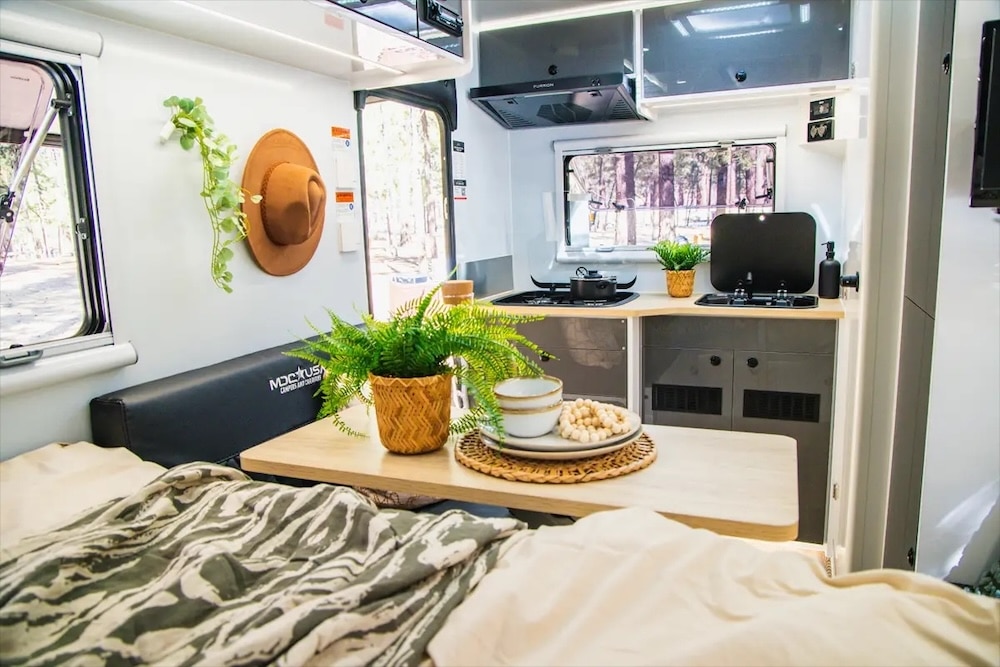
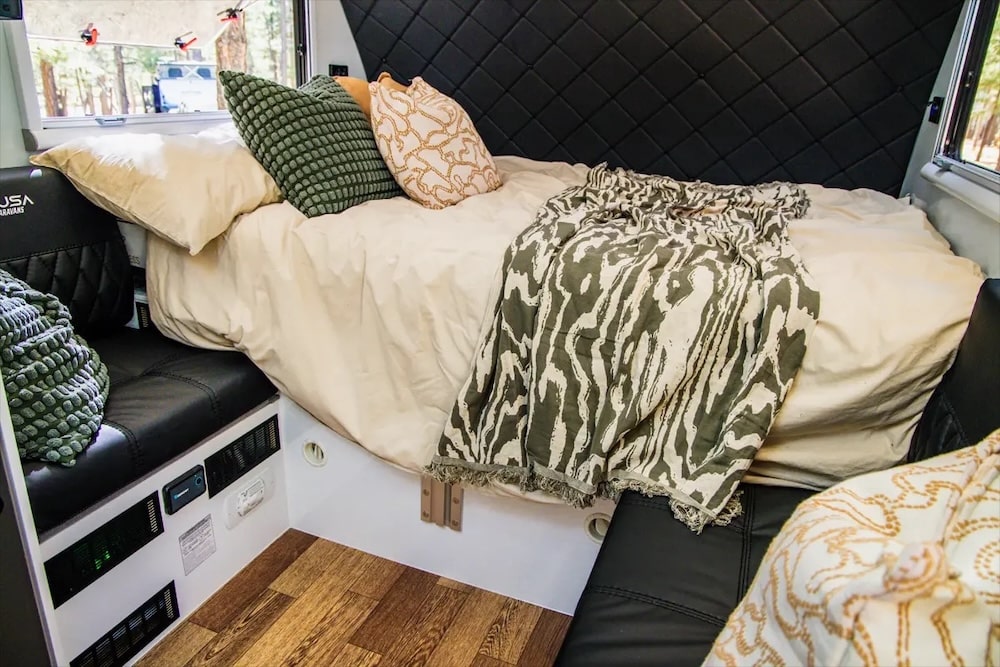
MDC USA brought its Australian-designed off-road lineup stateside, and the XT12HR is built the way you’d expect from a brand that cut its teeth on Outback terrain: X-TRACK independent coil-spring suspension, dual shock absorbers per side, and a DO35 articulating off-road hitch that flexes with the trailer instead of fighting it on uneven ground. The wet bath, with a Thetford cassette toilet and hot-and-cold plumbing, is a real bathroom in a 12-foot footprint, a luxury in this RV class
For someone who wants a trailer that can follow a Jeep or a lifted truck onto trails most travel trailers have no business being on, this is one of the more purpose-built options sold in the US.
Imported Off-Road Travel Trailer Options
If you’re willing to look beyond what’s readily available stateside, a couple of imported names come up constantly in off-road circles. Bruder, an Australian-built trailer with multiple off-road powerhouses, is a top contender for those willing to special-order an RV to the US.
Off Grid Trailers, out of Edmonton, Canada, builds the all-aluminum Expedition. It’s more accessible than Bruder through dealers in Colorado and Arizona, but it’s still a special-order trailer rather than something you’ll find sitting on a lot. Both are worth knowing about if money and lead time aren’t the limiting factor, but neither is a realistic weekend purchase for most American buyers.
What to Look for in an Off-Road Travel Trailer
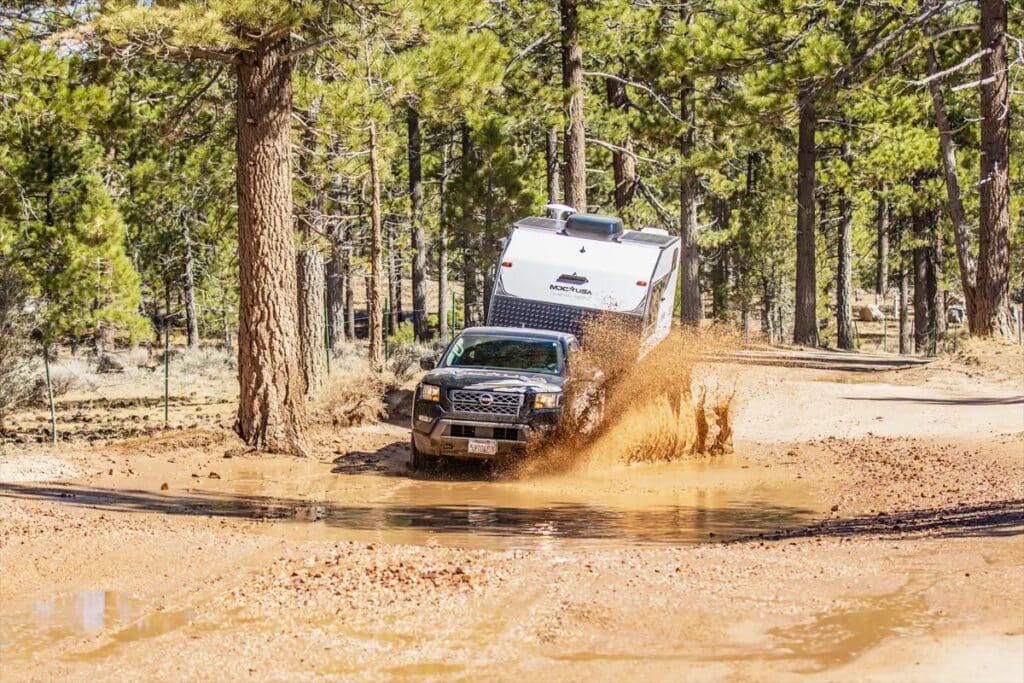
Off-road capability comes down to four things: ground clearance, suspension, chassis construction, and how much weight you can actually carry once you leave pavement.
Suspension matters more than almost anything else on this list. Independent suspension, whether it’s coil-spring, trailing-arm, or air, lets each wheel react to the terrain on its own. A standard leaf-spring axle, the kind on most conventional travel trailers, transfers every bump straight into the frame and everything bolted to it. If you’re only doing gravel forest roads, leaf springs are fine. If you’re doing anything rougher, independent suspension isn’t a luxury; it’s what literally holds your RV together.
Chassis construction is next. Galvanized steel or aluminum frames resist corrosion from mud, water crossings, and road salt in a way that a standard painted steel frame doesn’t.
GVWR and CCC matter more off-road than on the highway. A trailer that’s fine at its rated capacity on smooth pavement puts real structural stress on it off-road if it’s loaded anywhere near its limit. Leave yourself a margin, because every added pound increases pressure on your rig over rocky terrain.
On the brand side, the off-road trailer market breaks into three tiers: mainstream manufacturers with off-road lines (i.e., Rockwood Geo Pro/Flagstaff E-Pro and Ember), US-based specialty builders (i.e., Black Series, MDC USA, and TAXA Outdoors), and imported expedition brands available by special order (i.e., Bruder and Off Grid Trailers). Your budget, lead time tolerance, and how far off the beaten path you’re actually going determine which tier makes sense for you.
Frequently Asked Questions
You can absolutely boondock with a travel trailer, and you don’t necessarily need an off-road trailer to do it. Boondocking is about self-sufficiency: water capacity, battery storage, and solar. Many conventional travel trailers with a solid solar package and large holding tanks are capable of extended off-grid stays on flat BLM lots or dispersed campsites, as long as the sites are accessible via reasonably maintained gravel roads. Off-road capability matters more when getting to your boondocking spot requires navigating rough terrain.
In the travel trailer space, TAXA Outdoors, Ember, Black Series, and MDC USA consistently rank among the top off-road camper brands. For buyers willing to special-order, Australian brands like Bruder and Off Grid Trailers build some of the most capable expedition rigs available anywhere. Among more widely available options, Forest River’s Rockwood Geo Pro & Flagstaff E-Pro lineups offer an affordable entry point for buyers who don’t need extreme trail capability.
If you’re actually leaving maintained roads regularly, yes, off-road campers are worth the investment. The suspension and chassis differences will make or break your trailer’s lifespan. And trust me, you don’t want to see the business end of towing costs if your travel trailer breaks down in a remote area. But if your off-roading is mostly gravel campground roads and the occasional dirt lot, you can save money by choosing a standard travel trailer and skipping the off-road premium.
It depends on the terrain. For maintained gravel roads, forest service roads, and the occasional rough dirt lot, a standard leaf-spring axle is usually adequate. Where independent suspension becomes non-negotiable is on rocky trails, washboard roads, or uneven terrain, where each wheel needs to react independently to the ground beneath it. On a standard axle, one wheel hitting a rock transfers that impact directly through the frame and into everything inside your trailer. Independent suspension absorbs it. If you’re leaving maintained roads far behind, independent suspension can keep your trailer in one piece over the long haul.
What off-roading tech do you want to see in travel trailers? Discover our picks for the best travel trailers of 2026.
Ask us your RV questions and tell us about your favorite off-road travel trailers in the comments.