WHEN SOMETHING goes wrong with your RV on the road, it can feel overwhelming fast. Whether you’ve just had a tire blowout, woken up to a dead battery, or found your slide-out stuck in the open position, knowing what to do next means the difference between a minor detour and a ruined trip. This guide walks you through each step of handling an RV breakdown, explains when mobile RV repair is the right call, and shows you how Camping World’s mobile service can get you back on the road without the stress of a tow.
Key Takeaways
- If your RV breaks down, your first priority is safety. Get off the road, activate hazard lights, and set up warning devices before doing anything else.
- Mobile RV repair technicians can resolve many common breakdowns at your campsite, storage facility, or driveway, often without the cost and hassle of towing to a service center.
- Not every repair can be completed on-site. Knowing when to call mobile versus when to tow is one of the most useful things to learn before your next trip.
Why RV Breakdowns Are Different
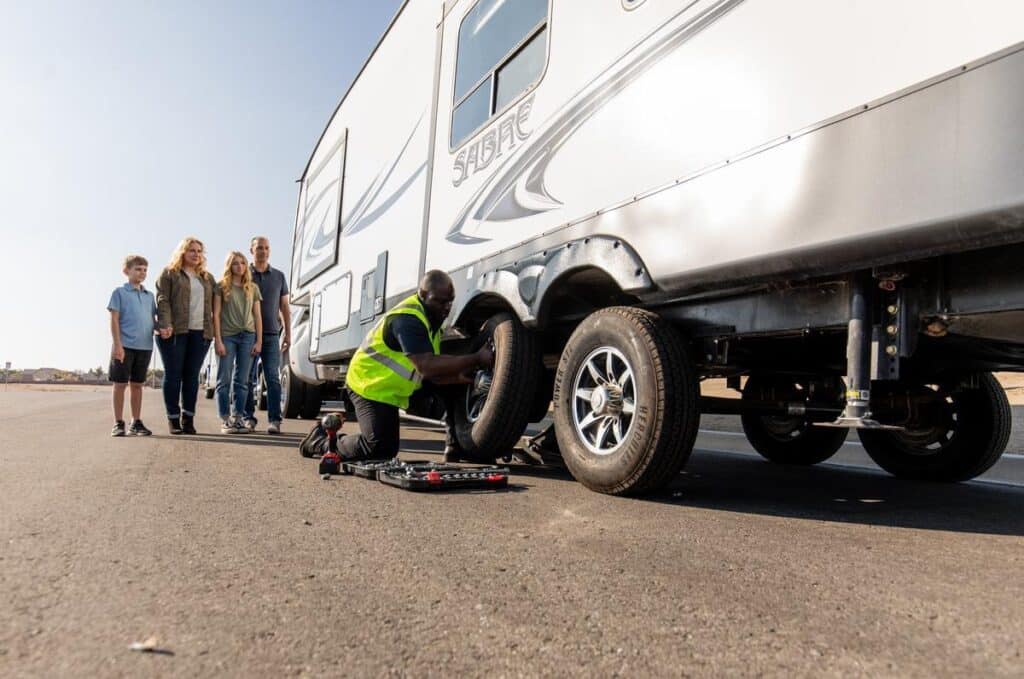
An RV is where you sleep, cook, and store everything for your trip. A breakdown displaces you from your temporary home, often leaving you, your belongings, pets, or family in an uncomfortable situation, possibly hundreds of miles away from your safety net.
RVs are also mechanically more complex than standard vehicles. They combine vehicle chassis systems with a home’s plumbing, electrical, HVAC, and appliance systems. That means more potential failure points and a wider range of technician expertise required to fix them. Not every roadside assistance service or local mechanic shop is equipped to handle RVs, which is why knowing your options before a breakdown happens is so important.
What To Do If Your RV Breaks Down
RV breakdowns happen for several reasons, but here are some simple steps to follow to ensure your safety and help you get back on the road as quickly as possible.
Step 1: Get to Safety First
The moment something goes wrong on the road — a blowout, a sudden loss of power, an engine warning light — your first and only priority is getting to a safe location. Here are some tips to help you do that:
Reduce your speed gradually. Avoid sudden braking, especially with a loaded RV in tow.
Move to the shoulder or an exit. Get as far off the travel lane as possible. A highway rest stop, exit ramp, or wide shoulder is far safer than stopping in an active lane or center median.
Activate your hazard lights immediately. Do this the moment you sense a problem. Don’t wait until you’ve stopped.
Set up warning devices once stopped. If possible, safely place reflective warning triangles or road flares behind your RV to alert oncoming traffic. Refer to the owner’s manual for instructions.
Keep passengers inside if it’s safe to do so. Standing on the shoulder of a busy highway is dangerous. Unless there’s an immediate safety reason to exit the vehicle, keep your passengers inside with their seat belts on until help arrives.
RV Pro Tip: Keep a roadside safety kit inside your RV at all times. Store it somewhere that’s easy to access in an emergency. Your kit should include reflective warning triangles, a high-visibility safety vest, a flashlight with fresh batteries, and a basic first aid kit.
Step 2: Assess the Situation
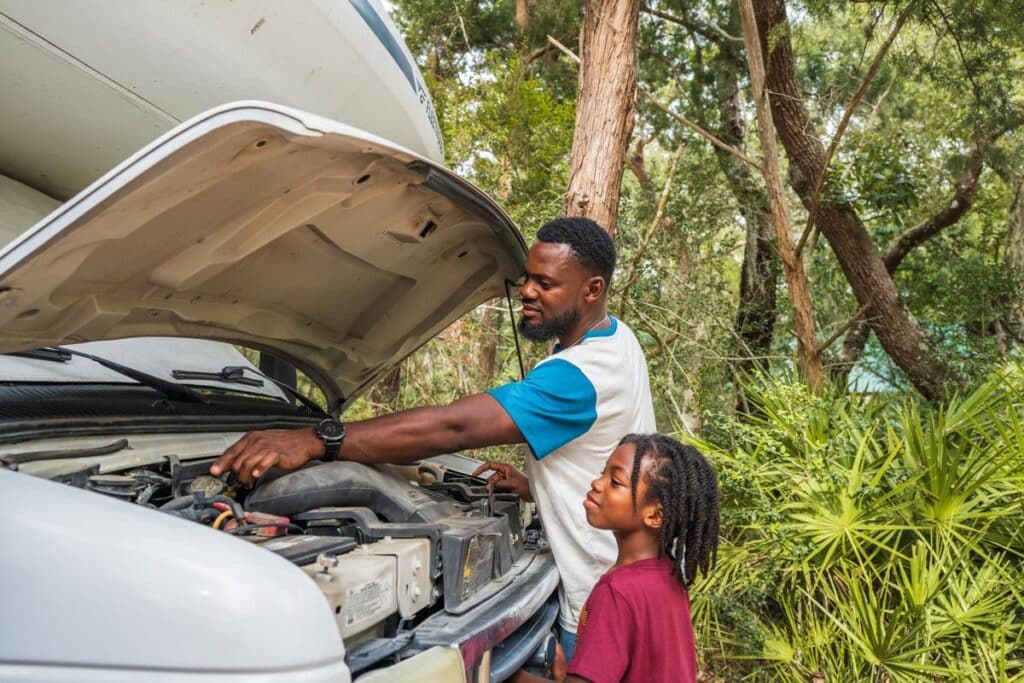
Once you’re safely stopped, it’s time to evaluate the extent of your breakdown. The information you gather here helps you communicate clearly with a technician or roadside assistance dispatcher. and it can mean faster, more accurate help.
Ask yourself:
- Is this a vehicle/chassis issue (engine, transmission, tires, brakes) or a living-quarters issue (electrical, plumbing, appliances, slide-outs)?
- Is the RV drivable, or does it need to be towed?
- Is there any visible smoke, fluid leaking, or smell of burning or propane?
Technician Tip: If propane is involved, double-check that the valves to your LP container(s) are off and do not use any ignition sources until the source of the smell is identified.
Document what you can. Take photos of visible damage, note any unusual sounds or smells you noticed before the breakdown, and note your exact location (mile marker, exit number, cross streets). This information speeds up the repair process and any insurance claims you may need to file.
Step 3: Determine Your Options
Not all RV breakdowns are resolved the same way. Depending on what failed and where you are, you have three main paths:
Option 1: Roadside Assistance
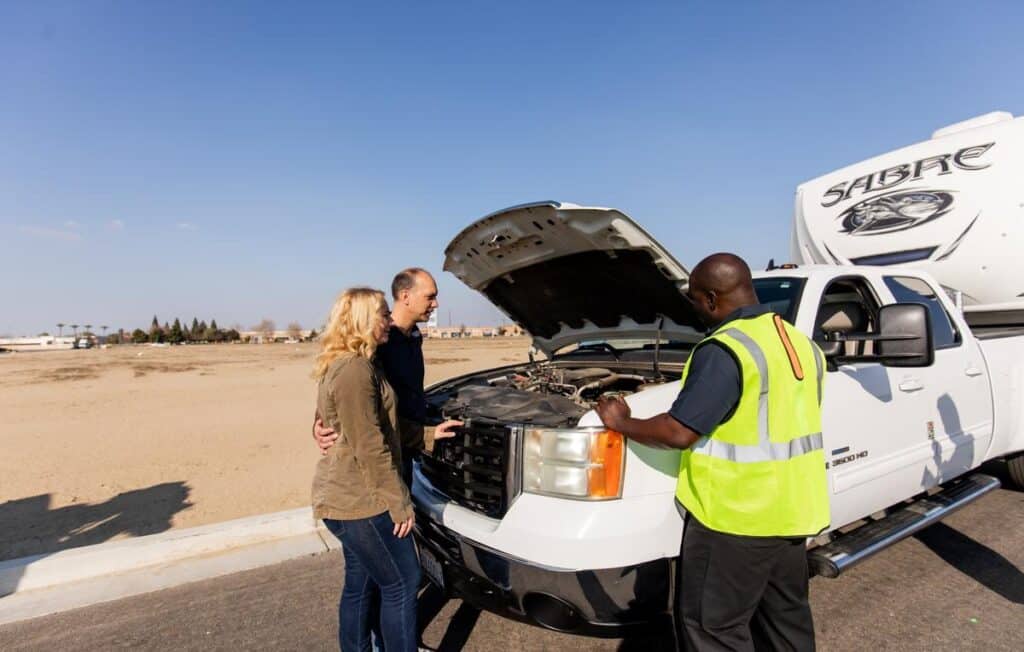
Roadside assistance is the right call when your RV is stranded and can’t be driven safely, or when you need immediate help that mobile repair can’t provide, such as emergency towing.
If you don’t already have a roadside assistance plan, it’s one of the most important investments you can make. Good Sam Roadside Assistance is one of the most widely used options in the RV community. Plans include unlimited-distance towing to the nearest service center, flat-tire assistance, battery jump-starts, emergency fuel delivery, and trip-interruption coverage.
AAA also offers RV-specific tiers in many regions with similar towing and emergency benefits. Many RVers also find that roadside coverage can be added directly onto an existing auto or RV insurance policy.
What roadside assistance typically covers:
- Emergency towing (check your plan for mileage limits and RV-specific coverage)
- Flat tire service
- Battery jump-starts
- Lockout service
- Emergency fuel delivery
What roadside assistance typically doesn’t cover:
- The actual repair. Towing gets you to a shop, but the diagnosis and fix are separate
- Living-quarters issues (slide-outs, appliances, plumbing, HVAC)
- On-site repairs at your campsite or driveway
Option 2: Mobile RV Repair
Mobile RV repair is the right call when your RV is already at a campsite, driveway, or storage facility — or when the breakdown is a living-quarters issue that can be resolved on-site. A certified mobile RV technician comes to you with the tools and parts needed to diagnose and fix the problem where you are, without requiring a tow.
Mobile repair is often the better choice when:
- Your slide-out is stuck, and you can’t move the RV
- Your RV’s air conditioner, water heater, or generator has failed at your campsite
- You have an electrical or plumbing issue at your site that’s making the RV uncomfortable or unusable
- Your RV is drivable, but has a living-quarters issue that needs attention
- You want to avoid the cost and inconvenience of towing and waiting at a service center
Option 3: Self-Help + Proceed to a Service Center
In some cases, you may be able to resolve the problem well enough to safely reach your nearest Service Center for a full inspection and repair.
Explore our detailed troubleshooting guides for many common RV systems.
These are intended to help you stabilize the situation — not perform full repairs — so you can safely reach a service center.
Step 4: Call for Help and Communicate Clearly
Whether you’re calling roadside assistance or a mobile RV technician, the information you share speeds up your service. Be ready to tell them:
- Your exact location — mile marker, highway or road name, nearest cross street or exit, GPS coordinates if available
- Your RV type and size — motorhome (Class A, B, or C) or towable (travel trailer, fifth wheel); total length; whether you’re also towing a vehicle
- What happened — describe the issue as specifically as you can: “I heard a loud pop and the rear driver’s side tire went flat” is more useful than “my tire broke”
- Whether the RV is drivable — this determines whether a mobile technician can help you on-site or whether towing is required first
- Any safety concerns — propane smell, smoke, fluid leaks, or unstable positioning on the shoulder
Most roadside assistance providers and mobile RV service advisors will also ask for your membership or customer information, so have that accessible before you call.
Step 5: While You Wait
Once help is confirmed and on the way, there are a few things you can do to make the situation safer and more comfortable while you wait:
Stay with your RV if it’s safe. In most cases, remaining inside or immediately beside your RV (on the non-traffic side) is safer than walking along the shoulder.
Keep pets secured. If you’re traveling with animals, keep them leashed or crated. A breakdown situation is a high-stress environment with unpredictable traffic.
Monitor your surroundings. If you’re in an unfamiliar or isolated area, keep your doors locked and your windows cracked rather than fully open if you need ventilation.
Document the breakdown. Photos and notes will be valuable if you need to file an insurance claim or warranty request later.
Notify someone of your situation. Let a family member, friend, or camp host know where you are and who you’ve called for help.
What Can a Mobile RV Technician Fix On-Site?
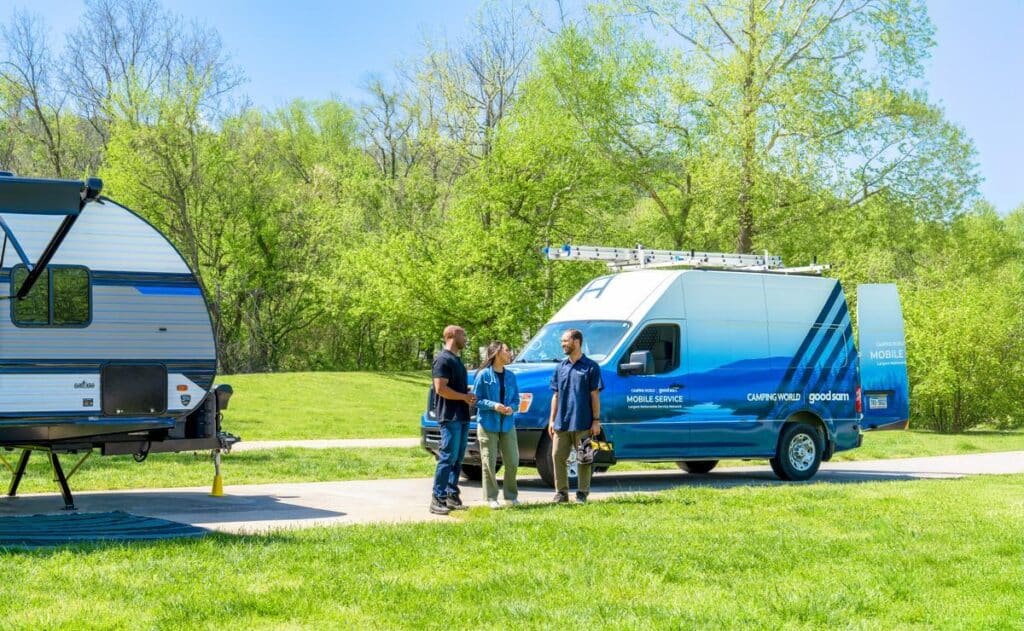
One of the most common questions RVers have about mobile service is what can actually be repaired without going to a service center. The short answer: more than most people expect. Mobile technicians commonly resolve issues with batteries, generators, air conditioners, water heaters, slide-out, electrical systems, and plumbing right at your location. Major structural repairs, extensive water damage, and engine or transmission work typically still require a service center.
If you’re unsure whether your specific issue qualifies (and what it will cost), the fastest way to find out is to call and describe the problem. A knowledgeable service scheduler can tell you on the spot.
For a full breakdown of fees, see our mobile RV repair cost guide, and to learn what’s usually in a mobile tech’s scope vs what requires a shop visit, read our guide to what a mobile RV technician can fix on-site.
When Should You Tow vs Call Mobile?
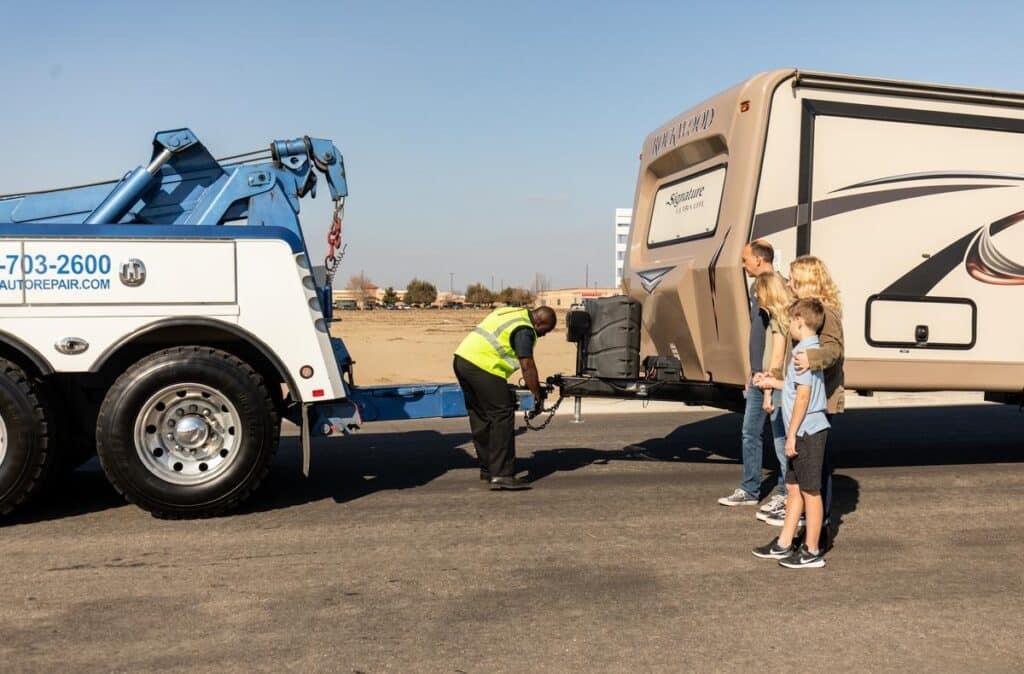
This is one of the most practical questions RVers face during a breakdown. Here’s a simple decision framework:
Call mobile RV repair when:
- The RV is already stationary at a campsite, storage facility, or home
- The issue is with the living quarters (appliances, plumbing, electrical, slide-outs, HVAC)
- The RV is drivable but has a system failure, making it uncomfortable or unusable
- You want to avoid towing costs and shop wait times for issues that can be resolved on-site
Call roadside assistance (tow) when:
- The RV cannot be safely driven due to a chassis, engine, or mechanical failure
- You’ve already had a mobile technician assess the issue, and a shop visit is required
- The failure involves systems that require a lift, specialized equipment, or a controlled environment to repair
- Safety is at risk, and you need immediate vehicle recovery
In some breakdown scenarios, you may need roadside assistance to tow you to a safe location, followed by a mobile technician to diagnose the issue.
How To Find Mobile RV Repair Near You
If you’re not in an area served by Camping World mobile service, here are the most reliable ways to find a qualified mobile RV technician:
- RVTAA (RV Technician Association of America) — a directory of certified RV technicians, searchable by location
- RVIA Find a Member — the Recreation Vehicle Industry Association’s member directory
- Your RV’s manufacturer — if your RV is still under warranty, the manufacturer may be able to locate a certified technician or mobile service near you
- Your campground host or manager — experienced campground staff often maintain a list of vetted mobile technicians in the area
- Your roadside assistance provider — some plans have relationships with mobile RV repair services in addition to standard towing
When evaluating any mobile technician, look for RVTAA or RVIA certification, ask for a written estimate before work begins, and confirm they’re licensed and insured in your state.
Frequently Asked Questions
Get to a safe location off the travel lane first. Activate your hazard lights, set up warning triangles or flares behind your RV, and assess whether the issue is with the vehicle chassis or the living quarters. Then call roadside assistance if you need towing, or a mobile RV technician if the issue can be resolved on-site. Document the breakdown with photos and notes before help arrives.
Mobile RV repair is a service where a certified RV technician travels to your location — a campsite, driveway, storage facility, or roadside location — to diagnose and repair your RV on-site. The technician arrives with tools, diagnostic equipment, and common parts. You’re charged for travel time, the diagnostic, and any parts and labor for the repair. Camping World offers mobile RV service at select locations nationwide; call your nearest location to confirm availability and schedule.
The most reliable starting points are the RVTAA (RV Technician Association of America) technician directory at rvtaa.org, your RV manufacturer’s warranty service network, and Camping World’s service locator at rv.campingworld.com/rv-service-maintenance. Camp hosts are also surprisingly good resources, as many maintain informal lists of trusted local mobile techs.
Good Sam Roadside Assistance is one of the most widely used and RV-specific roadside plans available. It includes unlimited-distance towing to the nearest service center in the US and Canada, flat tire assistance, jump-starts, emergency fuel delivery, and lockout service. Other options include Coach-Net, Escapees, and AAA. Coverage specifics and RV towing limits vary significantly by plan.
AAA offers roadside assistance for RVs, but coverage details depend on your membership tier and your RV’s size. Standard AAA plans have towing distance limits that may not be sufficient for large motorhomes or fifth wheels, and not all AAA contractors are equipped to tow RVs. AAA’s RV Plus plan offers enhanced towing coverage for larger rigs. If you rely on AAA for RV breakdown coverage, verify the towing limits and contractor availability in the regions where you travel before leaving home.
Based on service patterns, the most common RV breakdowns and repairs involve tires (blowouts and flats, especially on travel trailers with older or underinflated tires), batteries (failure due to age, improper storage, or parasitic drains), electrical issues (tripped breakers, converter or inverter failure, shore power connection problems), slide-outs (motor failure, alignment issues, seal problems), air conditioner failure (particularly in hot weather), water heater issues, and plumbing leaks. The good news is that most of these can be diagnosed and resolved by a mobile RV technician without requiring a tow.
Some do, some don’t. It depends on the technician’s certification and your RV manufacturer’s warranty authorization requirements. If your RV is under the manufacturer’s warranty, contact the manufacturer first to find out which technicians or service centers are authorized to perform warranty repairs in your area. Camping World Service Centers are authorized warranty repair facilities for many major RV brands.
More Resources:
- Emergency Essentials Every RV Owner Should Have On the Road
- How To Change a Tire on a Travel Trailer
- Essential RV Safety Tips for Every Road Trip
- RV Maintenance Checklist: Seasonal, Annual, and Pre-Trip Checks
Have you dealt with an RV breakdown on the road? Tell us what happened and how you handled it in the comments below.